Gustavo Dudamel Returns Joyfully to the Bowl with L.A. Phil
A Night of Jazz and Ravel at the Hollywood Bowl
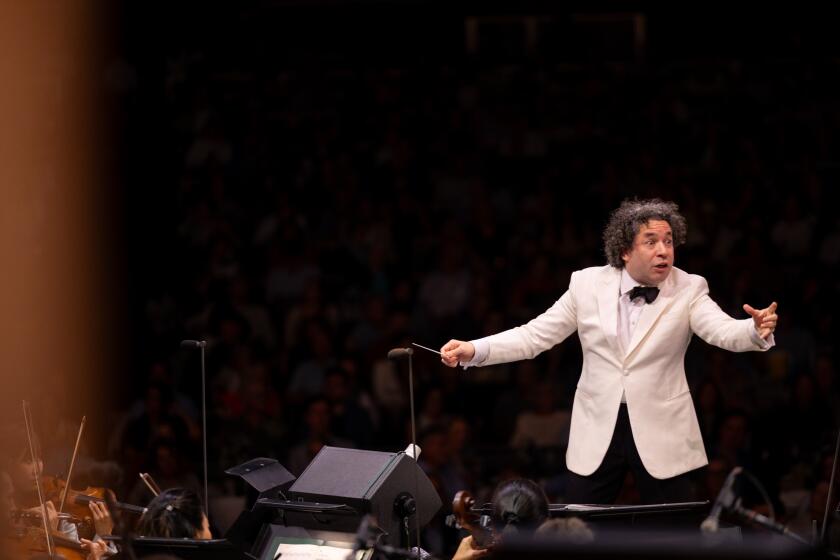
Tuesday night marked another memorable evening for Gustavo Dudamel at the Hollywood Bowl. This summer is significant as it celebrates the 20th anniversary of his U.S. debut, when he first took the stage at 24 years old with the Los Angeles Philharmonic. Since then, Dudamel has become a beloved figure at the amphitheater, known for his passion and deep connection to the venue.
As he walked onto the stage, Dudamel looked more like a proud patriarch with greying hair and a warm smile, greeting the nearly full house. The weather was pleasant, and the orchestra seemed genuinely happy, a rare sight for many ensembles.
This homecoming week was not just about celebration. It began on Monday with Dudamel conducting the Youth Orchestra Los Angeles (YOLA) as part of the annual YOLA National Festival. This event brings young musicians from across the country to the Beckmen YOLA Center in Inglewood. However, the week also carries a bittersweet note. Due to travel issues—though the exact reasons remain unclear—Dudamel's Simón Bolívar Symphony Orchestra of Venezuela will not be able to perform at the Bowl next week. As a result, he will have to stay behind in Caracas with the orchestra.
After two decades, Dudamel clearly knows what resonates at the Bowl. Yet, he continues to push boundaries, as evidenced by Tuesday’s performance that blended Duke Ellington with jazzy interpretations of Ravel. The soloist for the evening was Korean pianist Seong-Jin Cho, whose recent recording of Ravel’s complete solo piano works, along with his two concertos, has been a standout release in honor of the 150th anniversary of the French composer’s birth.
Ellington and Ravel had a mutual appreciation for each other’s work. When Ravel visited New York in 1928, he heard Ellington’s band at the Cotton Club, though his attention was more focused on Gershwin. Ellington, in turn, admired Ravel, and Billy Strayhorn, who contributed significantly to Ellington’s music, was deeply influenced by Ravel’s harmonic techniques and use of instrumental color.
Upon returning to Paris, Ravel composed his two piano concertos, with strong jazz influences. Cho performed both, framed by the symphonic tone poems “Harlem” and “Black, Brown and Beige,” which Ellington referred to as tone parallels.
While Ravel’s concertos are frequently performed, Ellington’s works are less commonly heard. Despite this, Ellington was well-regarded in the classical world. “Harlem” was originally intended for Arturo Toscanini and the NBC Symphony, and Leopold Stokowski attended the Carnegie Hall premiere of “Black, Brown and Beige,” alongside notable figures such as Eleanor Roosevelt, Marian Anderson, and Frank Sinatra. However, Ellington never fully embraced the crossover scene. The NBC version of “Harlem” never materialized and became a big-band score instead.
Ellington, known for composing during late-night hours after gigs, always wrote with the occasion and the players in mind. He often left orchestration to others, focusing instead on showcasing the improvisational talents of his band members. His scores were built on existing songs, with “Harlem” capturing the essence of the Harlem Renaissance and “Black, Brown and Beige” offering a sweeping narrative of the African American experience.
Both pieces are best known today through the orchestrations by Maurice Peress, which Dudamel used for the performance. The version of “Black, Brown and Beige” was shortened from 45 to 18 minutes, which some might find too brief.
The primary reason these works are rarely performed is that orchestras struggle to swing. However, the L.A. Phil has proven capable of anything, especially under Dudamel’s leadership. His success in taking the orchestra to Coachella has shown that the ensemble can tackle any challenge.
It’s time for orchestras to commission more experimental and timely arrangements. Even the Peress orchestrations, amplified through the Bowl’s sound system and supported by a jazz saxophone section, a jazz drummer, and other jazz-inclined players, captured the spirit of one of America’s greatest composers.
Ravel’s performance, however, did not fare as well. The left-hand concerto’s dark mysteries were challenging to convey over the vast space, and video close-ups of two-armed pianists trying to avoid the right hand were disconcerting. This summer, jumpy video footage has been a consistent source of distraction.
In contrast, Ravel’s G-Major concerto, with its sunny and jazzy character, remains a crowd-pleaser. Cho delivered a commanding performance, showcasing his polished technique, gleaming tone, and meticulous rhythms. While his interpretation of Ravel may not have matched the freshness he brought to Tchaikovsky’s First Piano Concerto at an L.A. Phil gala four years ago, the performance allowed Dudamel and the orchestra to revel in the Ravel that Ellington helped bring to life through jazz.

Post a Comment for "Gustavo Dudamel Returns Joyfully to the Bowl with L.A. Phil"
Post a Comment