Girls in Afghanistan Seek Faith-Based Education Beyond 6th Grade
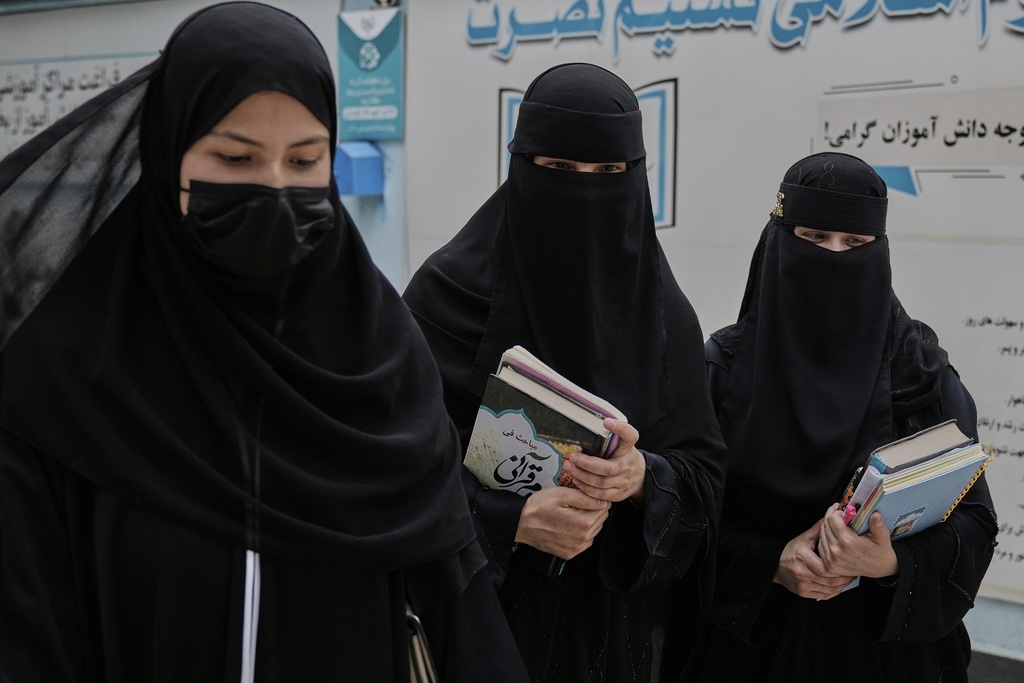
The Struggle for Education in Afghanistan
In the heart of Kabul, 13-year-old Nahideh spends six hours each day after school collecting water from a nearby shrine to sell to mourners visiting graves. Her dream of becoming a doctor seems increasingly out of reach. As the next school year approaches, she will be enrolling in a madrassa, a religious school, where she will learn about the Quran and Islam — but little else. “I prefer to go to school, but I can’t, so I will go to a madrassa,” she said, her dark brown eyes peering from beneath her black headscarf. “If I could go to school, then I could learn and become a doctor. But I can’t.”
Nahideh is in the last grade of primary school, which marks the end of education for girls in Afghanistan under the Taliban government. Three years ago, the regime banned girls from attending secondary schools and universities, making Afghanistan the only country in the world to do so. This ban is part of broader restrictions on women and girls, affecting everything from their clothing choices to their freedom of movement and who they can associate with.
With no access to higher education, many girls and women are turning to madrassas as an alternative. These religious schools offer a space for learning, even if it is limited to Islamic teachings. “Since the schools are closed to girls, they see this as an opportunity,” said Zahid-ur-Rehman Sahibi, director of the Tasnim Nasrat Islamic Sciences Educational Center in Kabul. “So, they come here to stay engaged in learning and studying religious sciences.”
The center’s student body includes around 400 individuals, ranging in age from about three to 60, with 90% being female. They study the Quran, Islamic jurisprudence, the sayings of the Prophet Muhammad, and Arabic, the language of the Quran. “Even before the schools were closed, many used to attend madrassas,” Sahibi noted. “But after the closure of schools, the interest has increased significantly, because the doors of the madrassas remain open to them.”
While there are no recent official figures on the number of girls enrolled in madrassas, officials suggest that the popularity of these institutions has been growing. In September, Deputy Minister of Education Karamatullah Akhundzada stated that at least 1 million students had enrolled in madrassas over the past year alone, bringing the total to over 3 million.
A New Path for Learning
At the Tasnim Nasrat center, students sit on the carpeted floor of a basement room, tracing lines of Arabic script in their Qurans. All 10 young women wear black niqabs, leaving only their eyes visible. “It is very good for girls and women to study at a madrassa, because the Quran is the word of Allah, and we are Muslims,” said 25-year-old Faiza, who recently enrolled at the center. “Therefore, it is our duty to know what is in the book that Allah has revealed to us, to understand its interpretation and translation.”
Faiza would have preferred to study medicine, but she now hopes that by showing dedication to her religion, she might eventually be allowed to pursue other studies. Medicine remains one of the few professions still open to women in Afghanistan. “When my family sees that I am learning Quranic sciences and that I am practicing all the teachings of the Quran in my life, and they are assured of this, they will definitely allow me to continue my studies,” she said.
Sahibi, however, believes that women should not be limited to religious studies alone. “In my opinion, it is very important for a sister or a woman to learn both religious sciences and other subjects,” he said. “Islam also recommends that modern sciences should be learned because they are necessary, and religious sciences are important alongside them. Both should be learned simultaneously.”
A Controversial Policy
The ban on female secondary and higher education has sparked controversy within Afghanistan, even among members of the Taliban. In January, Deputy Foreign Minister Sher Abbas Stanikzai made a rare public statement criticizing the policy, saying there was no justification for denying education to girls and women. His remarks reportedly led to his being placed on leave and possibly leaving the country.
Despite such dissent, the impact of the ban is clear. UNICEF Executive Director Catherine Russell warned that if the ban continues until 2030, over four million girls will be deprived of their right to education beyond primary school. She emphasized that the consequences for these girls—and for Afghanistan—will be catastrophic, affecting health systems, the economy, and the nation’s future.
The Role of Religious Education
For many in Afghanistan’s deeply conservative society, the teachings of Islam are fundamental. “Learning the Holy Quran is the foundation of all other sciences, whether it’s medicine, engineering, or other fields of knowledge,” said Mullah Mohammed Jan Mukhtar, who runs a boys’ madrassa north of Kabul. “If someone first learns the Quran, they will then be able to learn these other sciences much better.”
Mukhtar’s madrassa, which opened five years ago with 35 students, now has 160 boys aged 5 to 21. It offers limited classes in English and math, in addition to religious studies. There is also an affiliated girls’ madrassa with 90 students. “In my opinion, there should be more madrassas for women,” said Mukhtar, who has been a mullah for 14 years. He stressed the importance of religious education for women, noting that understanding religious verdicts helps them better comprehend their rights within the family structure.

Post a Comment for "Girls in Afghanistan Seek Faith-Based Education Beyond 6th Grade"
Post a Comment