Fern Leaf Pockets Reveal Plant-Microbe Secrets
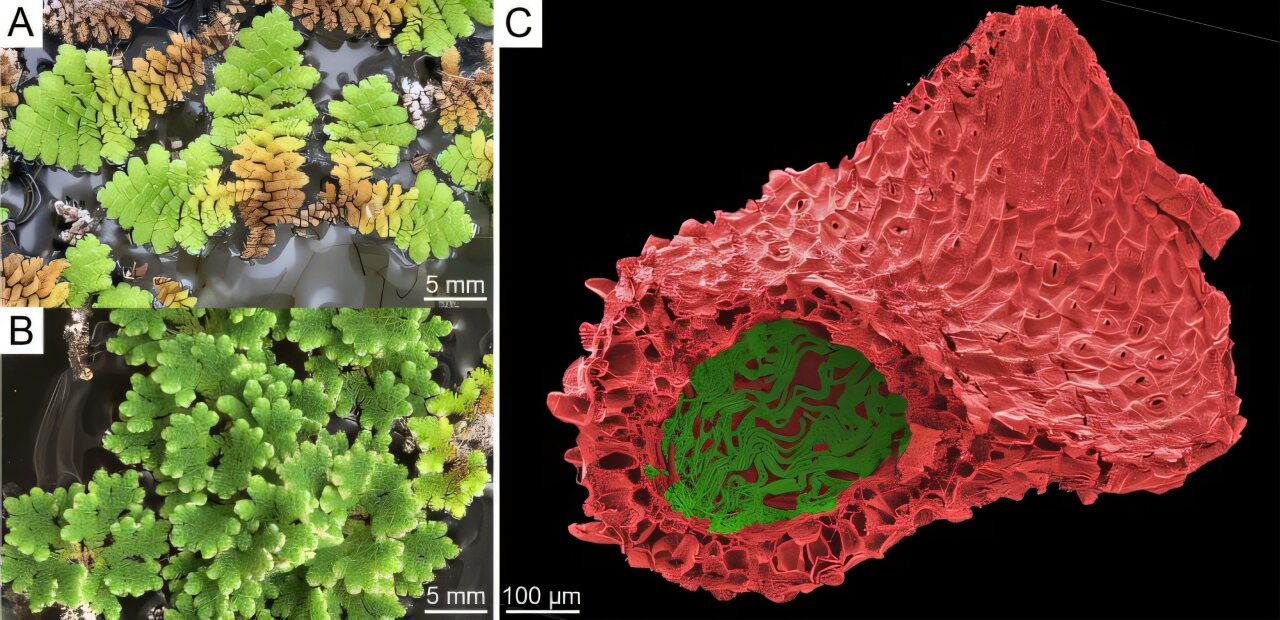
Understanding the Symbiotic Relationships in Azolla Ferns
Plants and microbes often form symbiotic relationships, where they rely on each other for essential nutrients or shelter. These interactions are crucial for addressing global challenges such as food security, carbon capture, and ecosystem restoration. Researchers are increasingly focusing on understanding and engineering these relationships to create sustainable solutions.
A recent study published in The ISME Journal has shed new light on the microbial communities within Azolla ferns. Azolla is a unique plant that grows rapidly and is found across various continents. It has been studied extensively due to its ability to fix nitrogen with the help of its microbial symbionts. This makes it a promising candidate for use as a biofertilizer and protein supplement for animal feed. Additionally, Azolla spores have been discovered in fossilized samples from 50 million years ago, during a period of global cooling, suggesting potential applications in carbon capture.
Exploring Microbial Communities in Azolla Leaf Pockets
The researchers at the Okinawa Institute of Science and Technology (OIST) focused their attention on the microbial communities within the leaf pockets of Azolla. These tiny hollow chambers within the leaves serve as habitats for symbiotic bacteria. The team aimed to determine which bacteria were present in different species of Azolla, what kind of symbiotic relationships existed, and how these bacteria evolved compared to their free-living counterparts.
By analyzing leaf pocket samples from various Azolla species and reconstructing the genomes of the microbial residents, the researchers identified that only one type of cyanobacteria, Trichormus azollae, was consistently present in all leaf pockets. This suggests that T. azollae is the primary symbiotic bacterium associated with Azolla.
While other bacteria were observed in some samples, the researchers believe these are transient visitors rather than true symbionts. This distinction is important for understanding the specific roles these microbes play in the plant's biology.
Genetic Impacts of Symbiosis
To gain deeper insights into the relationship between Azolla and T. azollae, the researchers compared the genome of the symbiotic cyanobacteria with that of its free-living relatives. They found that the symbiotic T. azollae had an extremely degraded genome, which may explain why it cannot survive outside the host plant.
According to Professor David Armitage, "There were more pseudogenes than functioning genes. Thirty to fifty percent of genes were lost in the symbiotic cyanobacteria compared to the free-roaming variants." This genetic decay likely results from evolutionary pressures that have weakened the need for certain functions over time.
Pseudogenes are remnants of genes that no longer function, often due to accumulated mutations. In the case of T. azollae, this may indicate that many of its original functions have become unnecessary in the protected environment of the leaf pockets.
Functional Genes in Symbiotic Bacteria
Despite the loss of many genes, the researchers identified several functional genes that are highly expressed in the symbiotic T. azollae. These genes are involved in adhesion, intracellular trafficking, secretion, and vesicular transport. These functions may help the cyanobacteria remain anchored within the leaf pockets and support nitrogen fixation, which benefits the host plant.
Conversely, genes related to defense mechanisms, stress responses, replication, and repair appear to be under relaxed selection or have been degraded into pseudogenes. This suggests that the symbiotic bacteria live in a relatively stress-free environment, where they do not need to defend against external threats or repair damage.
From Fundamental Insights to Practical Applications
The findings from this study offer valuable insights into the genetic and functional changes that occur during symbiosis. By understanding how these relationships develop, scientists can potentially engineer similar symbioses in other crops to improve agricultural productivity.
Professor Armitage emphasized the importance of this research, stating, "Our aim is that this work can act as a blueprint, guiding scientists on how to encourage such symbioses to tackle worldwide concerns like food security, by engineering nitrogen-fixing crops."
Plant-microbe symbioses have the potential to revolutionize agriculture and environmental sustainability if we can uncover the mechanisms behind their success. The example of Azolla demonstrates how tightly integrated these relationships can be, offering a model for future research and innovation.

Post a Comment for "Fern Leaf Pockets Reveal Plant-Microbe Secrets"
Post a Comment