Farthest Star Ever Seen May Be a Mystery
A New Perspective on Earendel
A unique natural phenomenon has enabled a space telescope to observe a star that existed when the universe was just 900 million years old. This remarkable discovery, made by NASA's Hubble observatory in 2022, set a new record for the farthest and earliest star ever seen. The star, named Earendel, which means "morning star" in Old English, has since become a focal point for astronomers eager to understand the early universe.
A year later, scientists turned to the James Webb Space Telescope for further investigation. With its larger mirror and ability to collect light at longer infrared wavelengths, the telescope provided more detailed observations. Initially, researchers thought they might have detected a companion star, an outcome they found surprising given the telescope’s capabilities.
Now, a new study published in The Astrophysical Journal Letters suggests that the light from Earendel may not be coming from a single star or even a close pair. The research, led by Massimo Pascale from UC Berkeley, reanalyzed previous data using computer models and proposes that Earendel could be a star cluster — a collection of stars rather than a solitary one.
Pascale shared his personal hope that Earendel is indeed an individual star, but the evidence points toward a more complex scenario. Scientists are particularly interested in studying ancient stars like Earendel because they offer insights into the mysteries of the early universe, which is estimated to be 13.8 billion years old.
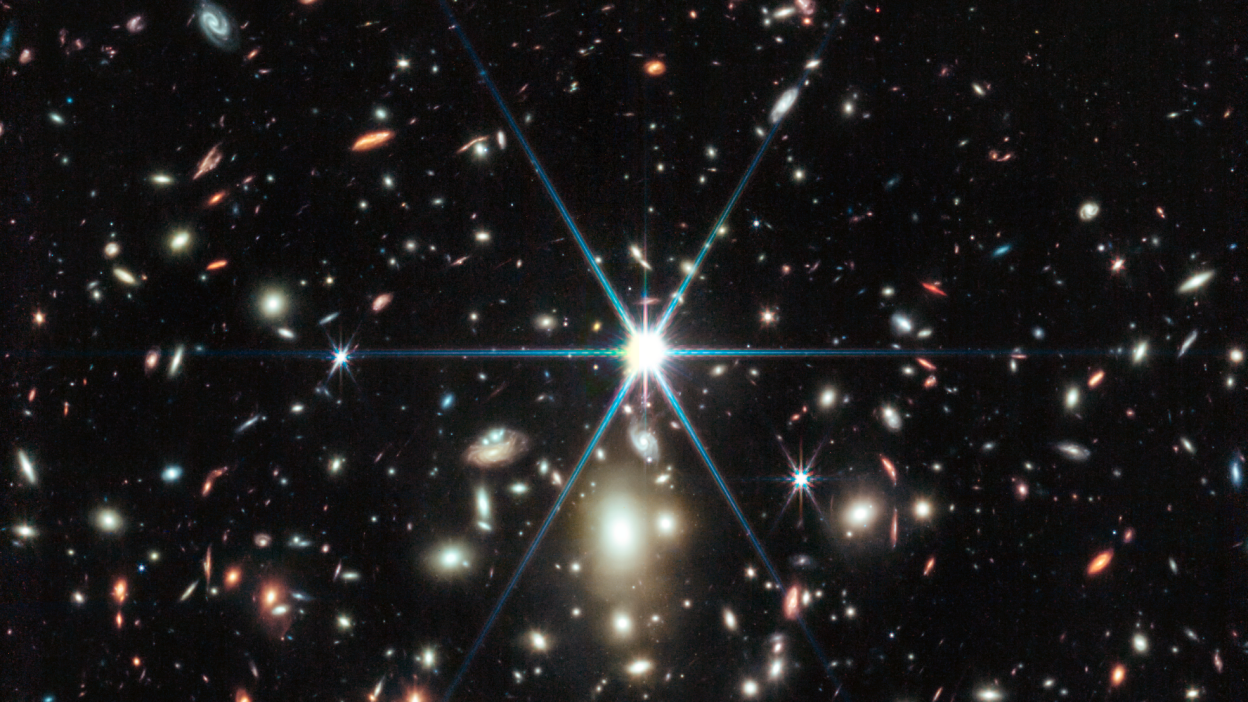
Earendel was first detected by Hubble through gravitational lensing, a phenomenon where massive celestial objects, such as galaxy clusters, bend and magnify the light from distant objects. This effect can be likened to a bowling ball placed on a trampoline, with the ball representing a massive object and the trampoline symbolizing the fabric of spacetime. Light passing through this warped space becomes distorted, effectively acting as a more powerful lens for telescopes.
However, gravitational lensing can also create multiple images of the same object, much like a funhouse mirror. In the case of Earendel, the galaxy cluster WHL0137-08 served as a colossal magnifying glass, allowing scientists to see the light from the Sunrise Arc galaxy, which existed 12.9 billion years ago. Today, due to cosmic expansion, the Sunrise Arc is approximately 28 billion light-years away from Earth.
While astronomers have extensive experience identifying gravitational lensing effects, this wasn’t always the case. In 1987, a blue arc initially thought to be one of the largest cosmic structures was later revealed to be an optical illusion caused by a galaxy cluster. This event highlighted the importance of careful analysis in interpreting astronomical observations.
For Earendel, some astronomers continue to question whether it is truly a star. Pascale and his team reassessed its size, considering the potential influence of dark matter, a mysterious substance that doesn't interact with light. Clumps of dark matter could affect the magnification, suggesting that Earendel’s size might align with a star cluster.
The researchers compared Earendel to a known star cluster in the same galaxy, called 1b. Both Earendel and 1b share similar characteristics: they are between 30 and 150 million years old, lack heavy elements produced by newer stars, and resemble ancient star clusters. While 1b fits well within star cluster models, so does Earendel, according to the study.
Pascale explained that if Earendel were a single star or a binary system, the alignment with the foreground galaxy cluster would need to be nearly perfect. However, if it is a star cluster, the alignment doesn’t need to be as precise.
Although the paper doesn’t specify the number of stars in the cluster, Pascale suggests that its mass could be equivalent to hundreds of thousands of suns. One way to determine whether Earendel is a lone star is to look for flickers in its light. If a star cluster is responsible, such fluctuations would likely be washed out by the combined light of multiple stars.
Despite the potential cost of securing telescope time for further observations, Pascale believes the scientific community would find the endeavor worthwhile. So far, colleagues have shown openness to the idea of Earendel being a star cluster, though Pascale emphasizes that the study doesn’t definitively prove this. He hopes the research contributes to ongoing discussions about the nature of Earendel.
"Maybe everybody keeps what their secret thoughts are about it a little bit more private," he said, "but most people are pretty happy to say, 'Yeah, a star cluster seems like an option.'"

Post a Comment for "Farthest Star Ever Seen May Be a Mystery"
Post a Comment