Education Dept's Funding Freeze Threatens Summer School and Language Programs for Families
The Struggle of a Single Mother and the Threat to Educational Programs
Sylvia, a single mother working as a janitor, feels the weight of uncertainty pressing down on her life. Her son, Gabriel, attends a summer learning program that has become a vital part of their daily routine. The program provides him with a safe environment, nutritious meals, and an opportunity to learn English. However, this lifeline is now under threat due to a decision by the Trump administration.
Gabriel is 10 years old, and Sylvia also takes care of her ailing mother. She often finds herself unable to sleep at night, worrying about what will happen if the program is shut down. “Gabriel is asking, ‘Mom, why are you crying? Why are you crying, mom?’” she says through a translator. The emotional toll is evident, and it’s clear that the program is more than just an after-school activity—it's a crucial support system for her family.
Aspire Afterschool Learning, where Gabriel spends his summers in Arlington, Virginia, is one of over 10,000 programs across the United States facing similar challenges. These programs have been put into a state of perilous uncertainty after the Department of Education paused a key grant that supports them. This grant, known as the 21st Century Community Learning Centers (21st CCLC), was part of nearly $7 billion in education grants that were suddenly frozen this month.
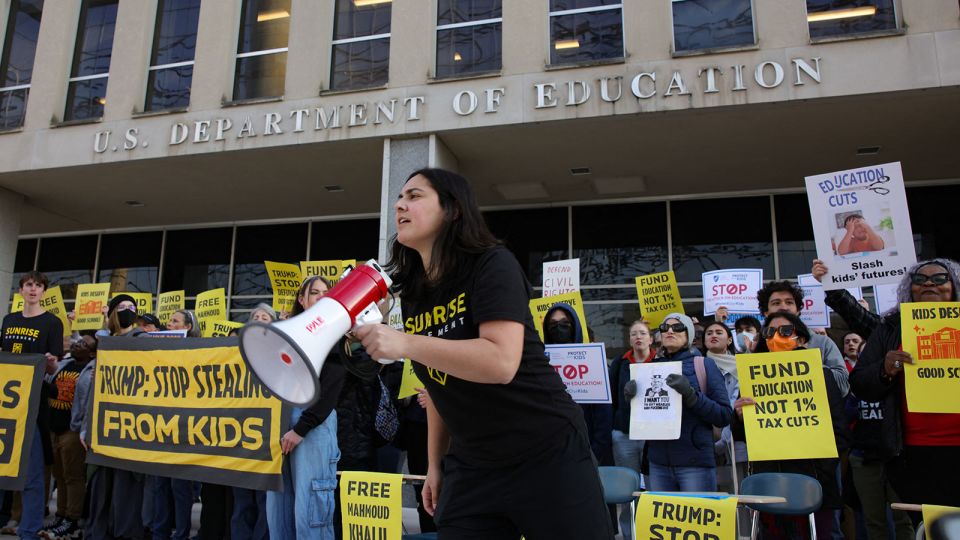
The freeze came amid a review that alleged the funds were being used to promote “leftwing” ideologies. The Trump administration has been pushing for the dismantling of the Department of Education, with mass layoffs and funding cuts under consideration. Much of the money goes towards programs that serve some of the poorest children in the country.
On Monday, a group of Democratic-led states sued the Department of Education in federal court to release the funds, which had already been approved by Congress. However, the impact of the freeze is already being felt, with many summer programs scrambling to stay open.
Immediate Impacts of the Freeze
The sudden halt in funding for K-12 programs includes money for teacher education, English language programs, student enrichment, and nonprofit learning centers. These programs are delivered through grants like the 21st CCLC, with state education agencies distributing the funds to grantees, including school districts and nonprofits.
One day before the funds were to be released, the Department of Education sent a letter stating that the money would not be coming, pending a review. “The Department will not be issuing Grant Award Notifications obligating funds for these programs on July 1 prior to completing that review,” the letter said.
This has caused many programs to question whether they can stay open this summer. Paula Fynboh, who runs Aspire, is trying to cobble together money through fundraising efforts like student-run lemonade stands. If the funds continue to be withheld, she will have to tell 25 families that their children will not be able to return.
Jodi Grant, executive director of the Afterschool Alliance, notes that many nonprofits are facing similar challenges. “They can try and keep their doors open an extra few days and extra few weeks and maybe if they’re lucky they have rainy day fund but you know that’s a Band-Aid that isn’t going to last forever,” she said.
Long-Term Consequences
Jim Clark, president and CEO of the Boys & Girls Club of America, warns that if these funds are blocked, the fallout will be swift and devastating. Many sites are running summer camps and programs, and nearly a fifth of the Boys & Girls Club network is funded by the 21st CCLC grant. Up to 926 Boys & Girls Club centers, serving more than 220,000 kids, could be forced to close if the funds are not released.
Addie Nardi, who runs a Boys & Girls Club in rural Maryland, describes the sudden funding freeze as “a kick to the gut.” The shock is secondary to the concern of how they will continue to serve these kids. If the funds don’t come through, the site will likely permanently close, leaving elementary students and their families without one of their only options for support in the area.
The impetus for the pause came from the White House Office of Management and Budget (OMB), which described it as part of an “ongoing programmatic review of education funding.” OMB raised concerns about how some of the funds may have been used by schools, citing examples such as English Language Acquisition funds being used to promote illegal immigrant advocacy organizations.
Grant, of the Afterschool Alliance, says the move feels extreme. “Nobody even knows what they’re reviewing,” she said. “If there’s a specific program that they’re concerned about, they should be investigating that program but not holding up funding for all of these other kids across the country.”
Looking Ahead
Beyond the immediate threat to summer schools, school districts and nonprofit education programs are bracing for more hardship into the school year. According to an analysis by the New America Foundation, school districts will lose an average of $220,289 if the funds continue to be withheld. Some stand to lose millions, with the poorest districts suffering the most.
Many school districts work with outside organizations to use federal grants to run after-school care or offer academic support for children from low-income families. For example, Aspire in Virginia runs after-school programs at a community center and two local schools that serve many low-income families.
The program regularly wraps up and discreetly sends home any leftovers to families in the program who would otherwise go without food. Kids who participate in the program earn points for academic and social achievements, and the difference it makes shows.
Monserrat, a little girl from Bolivia, shared that she feels happy because she now knows how to read. April, a rising 4th grader, said that Aspire helped her with her English, and now, she even helps translate for her parents.
The states suing the Department of Education are asking the court to issue a preliminary injunction to unfreeze the funds immediately in at least some states. Fynboh said she fears the day Aspire will have to close. “Walking by an empty classroom every day is going to be hard,” she said. “We know these kids and we know their parents, their faces, their names, their stories, their gifts, their talents, and we know which ones are going to lose access to the program. And that’s just heartbreaking.”

Post a Comment for "Education Dept's Funding Freeze Threatens Summer School and Language Programs for Families"
Post a Comment