Die Hard: A Wild Departure From Its Literary Roots
The Legacy of "Die Hard" and Its Literary Roots
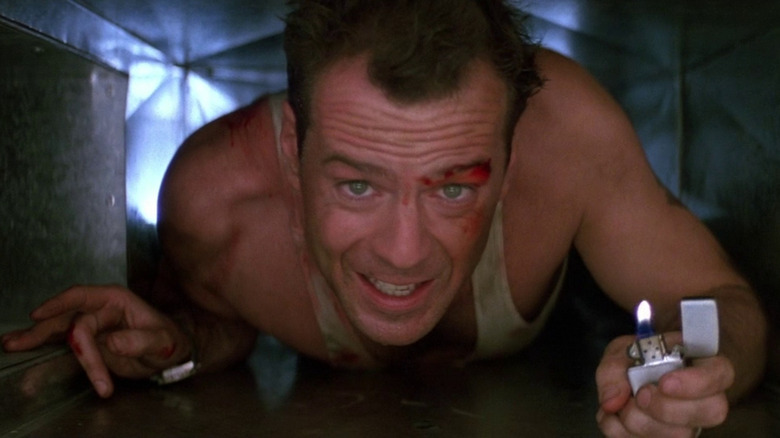
When "Die Hard" was released in 1988, it quickly became a cultural phenomenon. Starring Bruce Willis as John McClane, the film not only launched his career as a global superstar but also set the standard for action movies. With its mix of high-stakes action, humor, and emotional depth, "Die Hard" is often cited as one of the greatest action films ever made. It introduced audiences to a new kind of hero—one who wasn’t just a tough guy, but someone who had to rely on his wits and courage to survive.
In the movie, McClane finds himself trapped in a high-rise building during a Christmas party, where a group of terrorists led by Hans Gruber (played by Alan Rickman) takes dozens of innocent people hostage. Their goal is to steal a stash of bearer bonds, and McClane must fight his way through the building to save his estranged wife and others. The film's success was so profound that it gave rise to an entire subgenre of action movies, many of which followed a similar formula of a lone hero battling against overwhelming odds.
However, what many fans may not know is that "Die Hard" is actually based on a book—Roderick Thorp’s 1979 novel Nothing Lasts Forever. This novel itself is a sequel to another work, The Detective, which had previously been adapted into a film starring Frank Sinatra. Interestingly, Sinatra was originally offered the role of John McClane in the movie adaptation of Nothing Lasts Forever, but due to contractual obligations, he couldn't take part.
This complex history means that the film took several creative liberties with the source material. One of the most notable differences is the character of the protagonist. In the book, the lead is Joe Leland, a former NYPD detective who is no longer active in law enforcement. Unlike McClane, who is in his 30s and actively working as a cop, Leland is significantly older and has retired from his job. His reason for being at the high-rise building is not to visit his wife, but to see his adult daughter, who works there and is attending a Christmas party.
Another major difference lies in the villain. In the novel, the antagonist is Anton “Little Tony the Red” Gruber, a terrorist with whom Leland is already familiar. Unlike the film’s Hans Gruber, who is primarily portrayed as a bank robber, the book’s Gruber has a more complex motive: he is determined to steal documents that will expose the Klaxon Oil Corporation’s involvement in a corrupt business deal with a dictatorship in Chile. This adds a layer of political intrigue that is absent in the movie.
Perhaps the most significant change is the ending. In Nothing Lasts Forever, Leland watches helplessly as both Gruber and his daughter fall to their deaths from the skyscraper. This grim conclusion contrasts sharply with the film’s more hopeful ending, where McClane saves his wife and defeats Hans Gruber. It raises the question of whether "Die Hard" would have been as successful if it had ended on such a bleak note.
Despite these differences, the film remains a classic in its own right. Its impact on popular culture is undeniable, and it continues to be celebrated for its thrilling action sequences, memorable characters, and clever storytelling. While it may not follow the original book exactly, "Die Hard" proved that a well-told story can transcend its source material and become something truly iconic.

Post a Comment for "Die Hard: A Wild Departure From Its Literary Roots"
Post a Comment