DHS Insights on White Womanhood and American Empire Today
A New Perspective on “American Progress” and Its Legacy
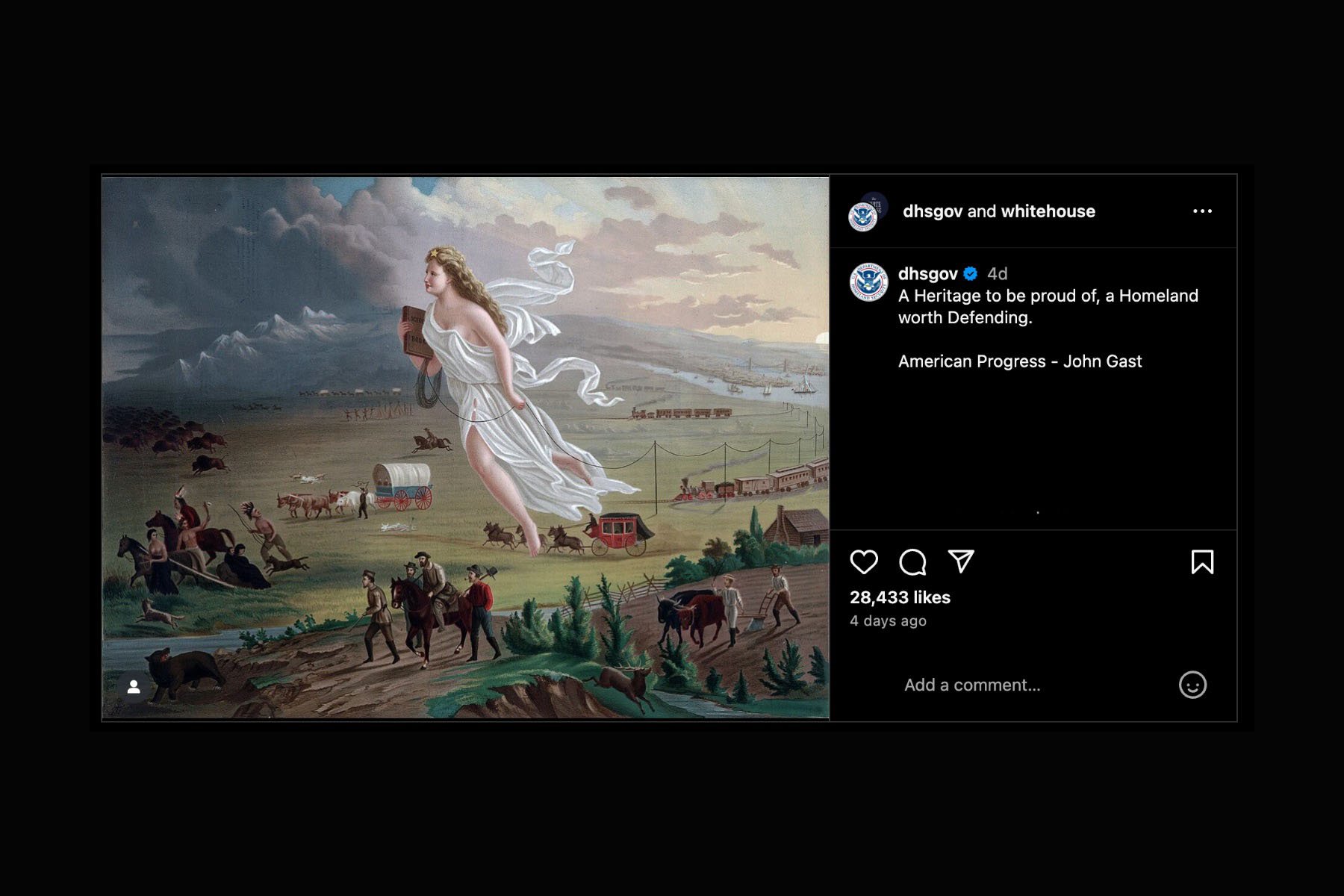
Last week, the official social media accounts of the Department of Homeland Security (DHS) shared a striking image that deviated from their usual content. Instead of showcasing action shots of Secretary Kristi Noem or law enforcement officers, they posted a 19th-century painting titled American Progress. This artwork, created by John Gast in 1872, depicts a floating white woman guiding the expansion of the American West, symbolically leading settlers, buffalo, and Native people out of the frame.
The painting is currently on display at the Autry Museum of the American West in Los Angeles. During the weekend, the museum hosted events for the National Day of the Cowboy and Cowgirl, an occasion where Stephen Aron, the museum’s director, invited The 19th to explore what this painting represents about America, empire, and White womanhood.
Since its appearance on DHS’ social channels on July 23 with the caption “A Heritage to be proud of, a Homeland worth Defending,” the image has sparked significant discussion. It stands in contrast to the agency’s recent content, which has included memes, vintage-inspired propaganda posters, and highly produced videos featuring law enforcement.
At the Autry, American Progress is part of a larger collection of wilderness-themed canvases that depict the American West as a land ripe for conquest. Most of these works feature people only minimally or not at all, with few exceptions. Next to American Progress is a large portrait of three white children and a dog, illustrating the ideal life settlers sought during the era of manifest destiny.
In real-life Los Angeles, where the Autry is located, the city has been central to the Trump administration’s federal immigration agenda. This agenda promotes a specific version of “Homeland’s Heritage” — one that emphasizes protecting White women and families.
Founded in 1988 by Gene and Jackie Autry, the museum aims to share the heritage and legacy of the American West. Its mission includes bringing together the stories of all peoples of the region. This is evident in the gallery where American Progress resides. Aron points out that three massive Navajo chief blankets are displayed across the room, offering a different kind of landscape. In the center of the room is an enormous sculpture called Grounded, created by third-generation Santa Clara Pueblo artist Rose B. Simpson.
American Progress was acquired after it was displayed as part of a controversial 1991 exhibit at the Smithsonian Museum of Art. This exhibit aimed to reinterpret art of the American West with fresh context on conquest and colonization. However, several lawmakers criticized the exhibit as overtly political, threatening to defund the institution in retaliation. Critics felt the exhibition unnecessarily vilified America’s history, contrasting sharply with the optimistic vision of progress in Gast’s painting.
This reaction echoes current American politics, as the Trump administration considers removing books about slavery from national parks and erasing factual information that “disparages” American history. Additionally, there are efforts to rename a warship honoring LGBTQ+ activist Harvey Milk. Executive orders seek to roll back mentions of gender, racial, and ethnic diversity from the federal government.
Experts at the Autry emphasize that the capital-H “Heritage” celebrated in the DHS caption is a layered form of romanticization. The painting depicts three waves of “American Progress,” with a floating white woman bearing “the star of empire” ushering Indigenous people and animals out of the frame, leading the way for miners and homesteaders. This reflects a view of the 1840s through the eyes of post-Civil War America, when the West represented a way to stitch together the nation and provide a rebirth.
For White Americans to settle in the West, they had to displace a diverse group of Indigenous, Spanish, and Mexican people. The main symbol and weapon of settlement was the White family, said Virginia Scharff, distinguished professor emerita at the University of New Mexico and chair of Western history at the Autry. The presence of White women was essential to the idea of permanent occupation of formerly Indigenous lands and the legitimacy of that occupation.
In Gast’s painting, White womanhood looms large, literally. Clad in classical white, the passive figure brings light westward, in contrast to the bare-breasted Indigenous woman, who embodies decency and civility. As this spectre of “progress” claimed new states in the mid-1800s, the rights of women diverged based on racial and ethnic background. Mexican women had more rights than American women in the East, including the ability to own property, while Native women were removed from ancestral lands and different cultural ideals were forced upon them.
At the same time, Gast’s floating, symbolic woman erases the very real contributions of women on the frontier. “You miss how much women were active agents of change in the West,” said Carolyn Brocken, senior curator at the Autry. They fought for their rights and communities — Wyoming was the first state to legalize women’s suffrage in 1869. Gender roles could be more fluid in frontier communities with limited resources, and women slowly gained more independence through expanded work and responsibilities.
Scharff sees the strategic deployment of the American Progress painting as deeply insidious. “The Department of Homeland Security is not sending scantily clad White women,” she said, “but instead sending guys with guns and truncheons and masks to grab people off the streets.” She described the situation as a deliberate deception that is both cynical and dangerous.
DHS Assistant Secretary Tricia McLaughlin stated that the agency “honors artwork that celebrates America’s heritage and history.” She added, “If the media needs a history lesson on the brave men and women who blazed the trails and forged this Republic from the sweat of their brow, we are happy to send them a history textbook.”
But at the Autry, context is everything. “We’re doing everything we can, both in the physical space and also when we’re doing interpretive work, to try to contextualize this kind of art in American history,” Scharff said. She considers Simpson’s Witness, which is usually displayed alongside American Progress, to be the most powerful piece in the entire collection. “It speaks to the people who are made invisible, muted and chased off the edge of the canvas by this type of art, but they’re still there,” she said. “Their presence is undeniable if you just look.”
When Simpson’s work was displayed in an eighteenth-century home, the artist commented on being “out of place.” “There have been times when I wanted to speak only to people who could understand my work,” Simpson said in an interview. “Yet if my sculptures are out of place, they’re actually working harder than if they’re surrounded by my context. I want my sculptures to go into difficult places; they’re intended to infiltrate.”
Witness has been temporarily replaced by its accompanying sculpture Grounded, a clay figure crouched on the ground with black wings reaching to the ceiling. Witness was relocated to the floor below as part of a temporary exhibit called Future Imaginaries: Indigenous Art, Fashion, Technology. Upstairs, Aron explains, the art is meant to remind patrons of the time before the beginning mythologized by painters like Gast. Future Imaginaries is meant to show that Indigenous history is not just in the past, but also that there is a present and a future.
In its temporary surroundings, Witness towers over Aron. He addressed its usual placement while standing in front of the post-apocalyptic clay figure. “Bearing witness to the paintings of manifest destiny stands, I think, if not as a rebuke, then at least as a reminder of whose homeland, whose heritage, who’s first and who’s still here,” he said.

Post a Comment for "DHS Insights on White Womanhood and American Empire Today"
Post a Comment