Democrats leverage competitive districts for key budget victories
A Historic Budget Deal in Wisconsin
Wisconsin’s recent state budget marks a significant shift in the political landscape, as it represents the largest funding increase for the University of Wisconsin System in nearly two decades. The budget also includes over $360 million to support the state’s child care industry and a $1.4 billion increase in revenue for public schools. This outcome was achieved through a rare bipartisan effort, with Senate Democrats trading their votes to help Republicans pass the budget earlier this month.
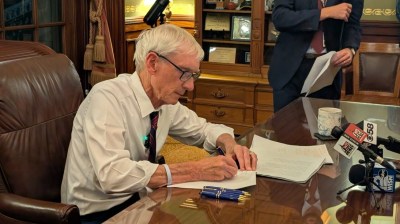
Governor Tony Evers, who will not seek re-election in 2026, emphasized the importance of collaboration. “Wisconsin is a purple state,” he said. “At the end of the day, it is my job as governor to get things done.” On July 3, Evers signed the $111 billion, two-year budget with bipartisan support, just a day before President Donald Trump signed his “One Big Beautiful Bill” without any Democratic support in Congress.
The budget was initially proposed by Evers in February with a $119 billion allocation. However, the GOP-controlled Joint Finance Committee, responsible for drafting the budget, significantly reduced most of the governor’s proposals when they began their work in May. Despite these challenges, the legislature needed Democratic support to pass the budget, as Republicans struggled to do so on their own.
Political Shifts and Compromise
The new, more competitive political districts in Wisconsin, following a 2023 ruling by the state Supreme Court, led to Democrats gaining 10 more seats in the Assembly and four in the state Senate last November. These tighter margins created a need for more compromise, giving the minority party some bargaining power.
However, not all Democrats were satisfied with the final outcome. State Rep. Francesca Hong, a Democrat from Madison, criticized the budget as a “false compromise dressed up as bipartisanship, but built on the backs of working families.” She argued that the budget lets Republicans off the hook while leaving communities without necessary investments.
Despite the criticism, experts noted that the reality of Republican control over both houses of the Legislature, combined with a hard deadline, limited the ability to drag out negotiations. UW-Stevens Point professor emeritus Ed Miller suggested that Democrats could not have gotten much more given the circumstances. He pointed out that if the budget had not been passed, Wisconsin would have lost federal health payments.
Key Provisions and Reactions
The Wisconsin State Senate passed the budget in a 19-14 vote, with five of the 15 Senate Democrats supporting it. These included Senate Minority Leader Dianne Hesselbein and several other lawmakers. In the Assembly, most Democrats voted against the budget, but a handful, including state Reps. Jill Billings and Steve Doyle, supported it.
Republicans rarely needed Democratic support to pass a budget since they gained control of the state Legislature in 2010. However, a slimmer majority and a right-wing faction unwilling to budge forced a new approach. Evers and those who supported the budget framed it as an example of compromise.
Hesselbein highlighted that the budget addresses key priorities such as funding public schools, making childcare more affordable, and investing in the UW System. The University of Wisconsin System received $256 million in state funding, although this falls short of the $800 million it requested.
Criticisms and Concerns
While the budget includes over $360 million for the child care industry, a third of that will go to direct payments to providers. However, experts like Miller note that Wisconsin’s support for public schools has lagged, with the funds primarily benefiting special education rather than students overall.
In 2023, Wisconsin ranked No. 26 in per-pupil spending, according to a report from the Wisconsin Policy Forum. This decline highlights concerns about the budget's focus on tax reductions rather than increased investment in education.
Senate Democrat Brad Pfaff praised the targeted tax cut, which he believes will provide relief for those earning less than $200,000. However, he expressed disappointment over the lack of investment in public schools, noting that the budget provided no new funding for school general aid.
Assistant Senate Majority Leader Dan Feyen, a Republican, touted the $1.4 billion in tax relief included in the budget. He emphasized the investment in special education and the cuts to more than 300 vacant positions in the state government. Feyen argued that the budget makes meaningful investments and reforms across key areas while delivering a sizable tax cut for Wisconsinites.
Looking Ahead
The budget deal reflects the changing dynamics in Wisconsin’s political landscape, with Democrats leveraging their newfound influence to secure some key wins. While the final outcome may not meet everyone’s expectations, it underscores the importance of compromise in a divided state government. As the state moves forward, the focus will likely remain on balancing fiscal responsibility with the needs of its residents.

Post a Comment for "Democrats leverage competitive districts for key budget victories"
Post a Comment