Camp Dream. Speak. Live.: A Trailblazer's Journey
A Journey of Confidence and Communication
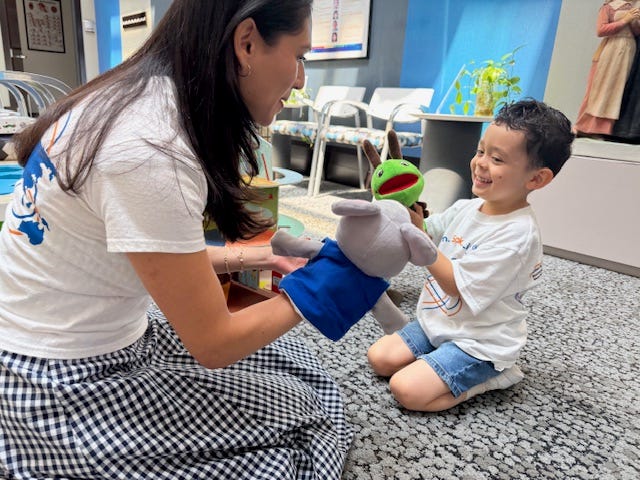
Speech therapist Ana Hernandez works with 4-year-old Itza Vazquez, who has a unique way of expressing herself. “My name is Itza, and I am a person who stutters,” she says confidently. “Duh, duh, duh dinosaur, was that a stutter?” she asks the toddler. “Uh, yes,” he giggles.
Itza’s mother, Liliana Diaz-Vazquez, first noticed her son had a bit of a stutter about a year ago. She recalls, “He started preschool and we noticed some disfluency. He was blocking on words, repeating words.” The family has a history of stuttering on the male side, so it wasn’t entirely unexpected.
Knowing this, Diaz-Vazquez felt a sense of preparedness when she learned she was having a boy. “We thought this might have this potential situation.” As Itza grew, his frustration with certain words and phrases became more apparent. This led to enrolling him in Camp Dream. Speak. Live., a weeklong program for kids and teens who stutter.
The Camp Experience
Camp Dream. Speak. Live. is the first of its kind in Chicago. It serves students aged 4 to 17, offering a supportive environment where children can learn and grow. Hernandez, who leads the camp, explains, “The teenagers learn and watch the young kids speak without a care, in their natural voice, stuttering openly and the little kids learn from the older kids about how responsible they are and how openly the stutter and communicate.”
The camp was made possible through a partnership between DePaul University, the Arthur M. Blank Center for Stuttering Education and Research, and Adult Stuttering Services of Chicago. Dr. Jessica Wacker, from DePaul University, describes the initiative as a nonprofit clinic that operates as a living classroom. “Our missions alight so well,” she said.
Wacker shared her own experience, recalling, “When I was in school, we were taught how to change a stutter, that’s what I learned and that’s what I did.” However, new research has shifted the approach. “I’ve since learned there’s nothing to change with a person who stutters but their confidence and their ability to have their message heard.”
Understanding Stuttering
Stuttering affects at least 1% of the population, with 3 out of 4 being boys. According to Hernandez, “Stuttering is neurophysiological, which means that the way your brain creates, processes, and executes the motor signals needed for speech is a little bit different in a person who stutters.” This difference is part of who they are for life.
Parents often notice stuttering around the age of 3 or 4. If a child stutters for more than 3-4 months, it may indicate a lifelong condition. Contrary to common beliefs, stuttering cannot be cured. “People who claim to stutter less are likely hiding it,” Hernandez said. “For people who go through the trouble of trying to hide their stutter so intensely, it takes over their lives.”
The CARE Model
Hernandez uses the CARE Model, a groundbreaking approach based on 20 years of research. It focuses on effective communication rather than changing stuttering. The acronym stands for communication, advocacy, resiliency, and education. “Communication teaches them to stand tall, to speak loudly, to look at whoever they are speaking to, to use the words as opposed to avoiding words that they would normally use and that will include open stuttering.”
However, the challenge remains in changing the narrative around stuttering. “Stuttering is so stigmatized that families feel not ready to take this one sometimes,” Hernandez said. “We know we are changing the narrative. We are telling people stuttering is ok.”
Embracing Natural Speech
At no point do they try to reduce stuttering. Instead, they focus on improving speech by encouraging more communication. “We’re telling them that’s the way they naturally talk and we love the way they naturally talk.” Hernandez draws a parallel to societal changes, such as the acceptance of left-handedness and asthma.
For Itza and his family, the impact of the camp and its philosophy has been profound. “This model really opened my eyes to supporting people who stutter,” said Diaz-Vazquez, who is also a speech therapist. “I’ve seen a difference in my son’s communication, he’s more confident now.”
Dr. Wacker emphasizes the importance of advocates and allies in making a difference. “We want to be those change makers in our field. The more of those there are, the more accepting the community will be.”
A Community of Support
Camp Dream. Speak. Live. aims to create a space where individuals who stutter feel welcomed and understood. “To stutter openly is what the camp aims for. If we ask a person not to stutter, we are asking them not to talk, essentially.” The camp focuses on building confidence, communication skills, and a sense of community.
Hernandez was recently recognized as Speech Therapist of the Year at the National Stuttering Association conference, highlighting her significant contributions to the field. For more information about her work, the Blanc Center, or the camp, visit their website.

Post a Comment for "Camp Dream. Speak. Live.: A Trailblazer's Journey"
Post a Comment