Bacterial Sensors Detect Arsenite and Cadmium in Real Time
Advancements in Bioelectronic Sensing with Engineered E. coli
Scientists at Rice University have made a breakthrough by developing genetically modified E. coli that function as living multiplexed sensors. These bacteria are capable of detecting and responding to multiple environmental toxins at once, converting their biological reactions into electrical signals that can be read. This development paves the way for real-time, remote monitoring of water systems, pipelines, and industrial sites, with potential future uses in biocomputing.
A recent study published in Nature Communications presents a novel method for on-site detection of arsenite and cadmium at levels set by the Environmental Protection Agency (EPA). The research, led by Xu Zhang, Marimikel Charrier, and Caroline Ajo-Franklin, addresses a key limitation in current bioelectronic sensors, which typically require separate communication channels for each target compound. By implementing a multiplexing strategy, the team significantly increases information throughput, utilizing bacteria's natural sensitivity and adaptability within a self-powered system.
"This system represents a major leap in bioelectronic sensing, encoding multiple signals into a single data stream and then decoding that data into multiple, clear yes-or-no readouts," said Ajo-Franklin, the Ralph and Dorothy Looney Professor of Biosciences and corresponding author of the study.
Engineering Bacteria to Generate Electrical Signals
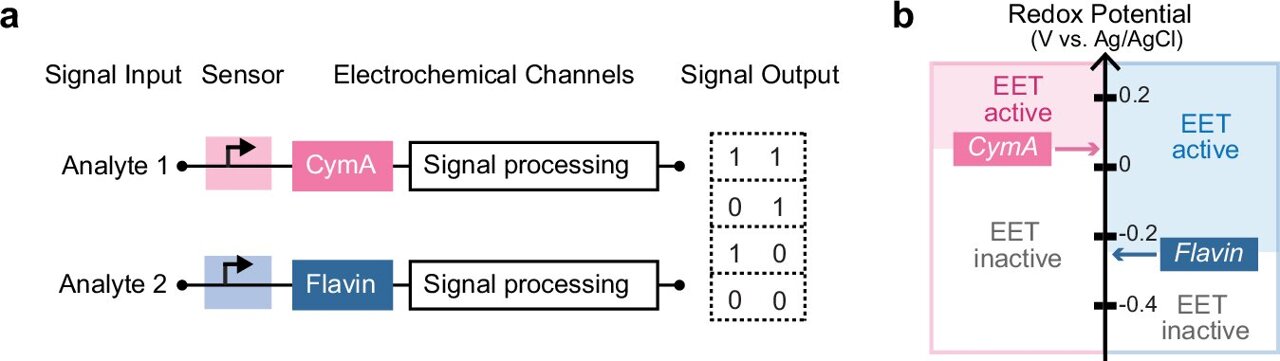
Traditional bioelectronic sensors use engineered bacteria to produce electrical signals, but each analyte usually requires its own dedicated bacteria. The researchers were inspired by fiber-optic communication, where different light wavelengths carry distinct data streams over a single cable. They hypothesized that electrical signals at varying redox potentials could similarly multiplex information from a single sensor.
"We needed to determine how to robustly separate signals of different energies regardless of the sample or toxin," said Zhang, the study co-author and a biosciences postdoctoral researcher.
The research team developed an electrochemical method that isolates these redox signatures and converts them into binary responses indicating the presence or absence of each toxin. Their work combined synthetic biology with electrochemical analysis, programming engineered E. coli strains to interact specifically with either arsenite or cadmium, resulting in distinct electrical responses.
The system can simultaneously report on two toxins using a unified electrode setup by employing a sensor array that distinguishes these redox signatures.
Detecting Dual Threats, Maximizing Impact
The multiplexed sensors successfully detected arsenite and cadmium at EPA-standard thresholds in environmental tests. This capability is crucial, especially given the potential for synergistic toxicity when both metals are present, a scenario that poses a greater risk than either contaminant alone.
"This system allows us to detect combined hazards more efficiently and accurately," said Charrier, the study co-author and a bioengineering senior research specialist. "Moreover, because the platform is modular, it could be scaled up to screen for more or different toxins simultaneously."
By integrating wireless technologies, the implications of the system extend beyond heavy metal monitoring. For example, the sensor could enable real-time, remote surveillance of water systems, pipelines, and industrial sites.
The underlying bioelectronic framework also points toward future applications in biocomputing, where engineered cells could not only sense and store environmental data but potentially process and transmit it via electronic interfaces.
Building the Future of Biodigital Interfaces
This study lays a foundation for advanced biodigital integration. The research team's work marks an early but notable step toward developing intelligent, self-powering biosensor networks.
As the field of bioelectronics continues to evolve, the researchers say they envision multiplexed, wireless bacterial sensors becoming essential tools that can be deployed at scale for environmental monitoring, diagnostics, and even biocomputational tasks, all powered by microorganisms.
"A key advantage of our approach is its adaptability; we believe it's only a matter of time before cells can encode, compute and relay complex environmental or biomedical information," Ajo-Franklin said.
More information: Xu Zhang et al, Multichannel bioelectronic sensing using engineered Escherichia coli, Nature Communications (2025). DOI: 10.1038/s41467-025-62256-1

Post a Comment for "Bacterial Sensors Detect Arsenite and Cadmium in Real Time"
Post a Comment