Are China's Aircraft Carriers Nuclear-Powered?
The Evolution of Naval Power: China's Pursuit of Nuclear-Powered Aircraft Carriers
In the modern naval landscape, aircraft carriers have become symbols of national power and influence. These massive vessels serve as mobile airbases, enabling a country to project military strength across vast distances. Among the key technologies that define the capabilities of these carriers is nuclear propulsion. This technology allows for extended range, increased speed, and greater operational flexibility, making it a critical asset for any nation seeking global military presence.
The United States leads the world in nuclear-powered aircraft carriers, with its fleet of eleven Ford and Nimitz-class carriers ensuring a strong global military footprint. While other nations operate aircraft carriers, only France possesses a nuclear-powered one—the Charles de Gaulle, a 42,000-ton vessel that represents a unique capability in European naval forces. However, the balance of power may be shifting as China, the world's largest naval fleet operator, looks to expand its own carrier capabilities.
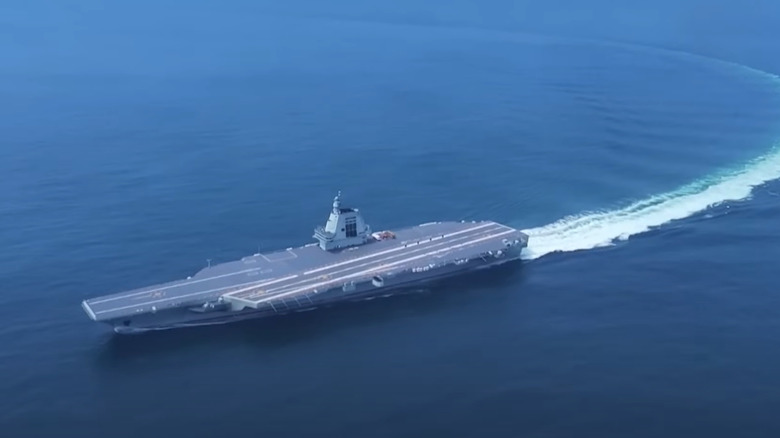
China has added three aircraft carriers since 2012, placing its fleet among the largest in the world. Despite this growth, all of China’s current carriers rely on traditional steam-powered engines. The Liaoning, commissioned in 2012, displaces 60,000 tons and carries around 41 fighter jets and helicopters. The Shandong Type 0002, commissioned in 2019, is similar in size and capacity. The third carrier, the Type 003 class Fujian, is currently undergoing trials in the Yellow Sea and is expected to become operational by the end of 2025.
The Fujian represents a significant leap forward for China’s naval ambitions. At 80,000 tons, it is the largest non-nuclear ship in the world, surpassing all but the U.S. nuclear-powered carriers. Equipped with China’s first electromagnetic aircraft launch system, the Fujian will allow for more efficient and versatile aircraft operations. Experts believe this development could provide the experience needed to build a fourth carrier—likely a nuclear-powered supercarrier capable of rivaling American models in both size and capability.
Recent satellite images from late 2024 suggested that China was constructing a land-based prototype nuclear reactor designed for a large surface ship near Leshan. These findings were followed by images from the Dalian shipyard, which showed what many believe to be early designs for a Type 004 carrier. These developments have raised concerns among Western observers, who are watching closely as China expands its naval capabilities.
In November 2024, researchers at the Middlebury Institute of International Studies discovered evidence of a nuclear reactor prototype built by China’s 701 Institute. According to their report, this reactor is likely part of a project dubbed "Dragon Might," which aims to develop a nuclear-powered aircraft carrier. Three months later, images from the Dalian shipyard revealed engineers working on a supercarrier equipped with four electromagnetic catapult systems. While some remain skeptical, these reports suggest that China is making significant progress toward its goal of fielding a nuclear-powered carrier.
Historically, China has focused its naval operations within the South China Sea, particularly within the so-called first island chain. However, recent years have seen an expansion of its naval activities beyond these boundaries. Adding a nuclear-powered carrier like the Type 004 could enable China to extend its influence into regions such as Africa, Latin America, and the Middle East, where it has made substantial investments in infrastructure and maritime assets.
Analysts speculate that China may use these investments to establish naval outposts, much like its expansion of the Djibouti port into a military base. As China continues to build its naval capabilities, the global balance of power may shift in ways that could reshape international security dynamics.

Post a Comment for "Are China's Aircraft Carriers Nuclear-Powered?"
Post a Comment