Alternative Carbon Tech Boosts Oil and Storage
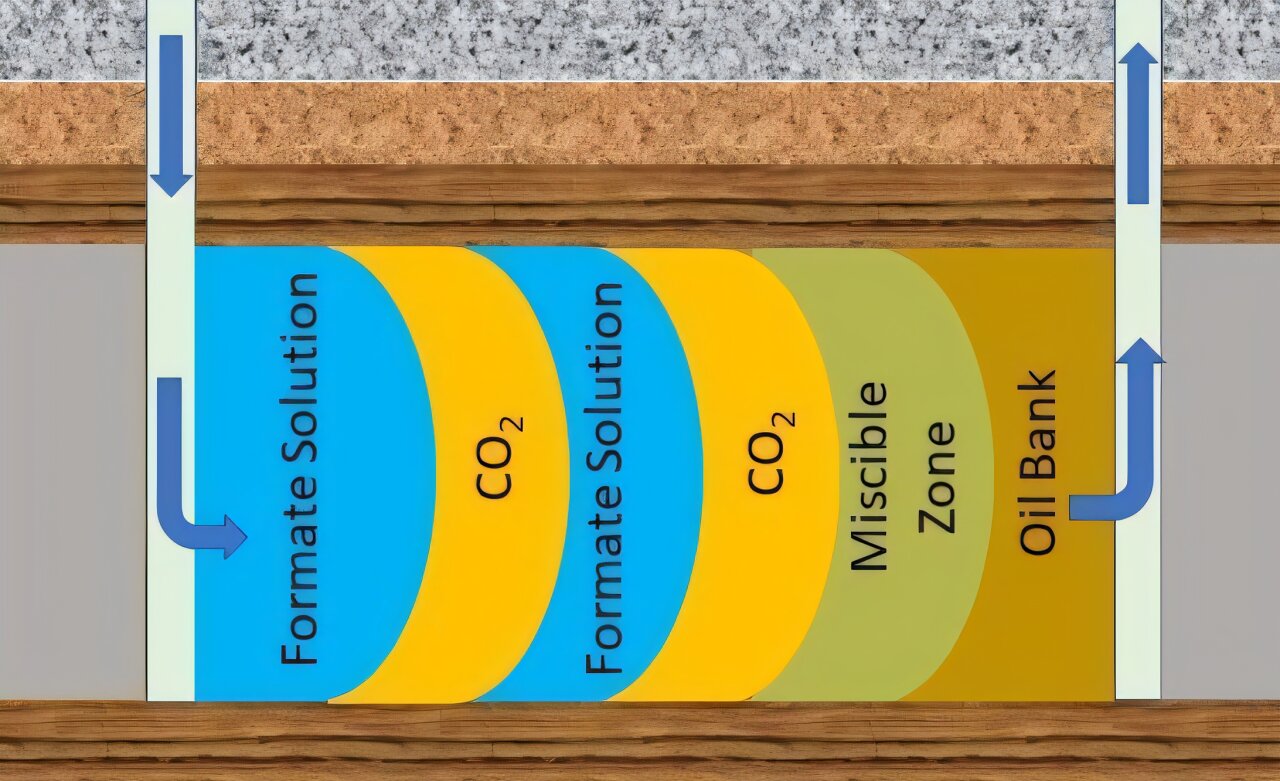
A New Approach to Enhanced Oil Recovery
A groundbreaking method for enhanced oil recovery (EOR) has been developed by researchers at The University of Texas at Austin. This innovative technique is showing significant promise in modeling studies, offering improved oil recovery, increased carbon storage, and enhanced safety compared to traditional EOR methods.
The research focuses on alternative carbon carrier technology, which involves the use of chemical compounds specifically designed to store larger amounts of carbon molecules in subsurface formations. These compounds can be synthesized from carbon dioxide (CO2), making them a potential tool for optimizing the transportation, utilization, and storage of this greenhouse gas.
In a recent study conducted by researchers from the Jackson School of Geosciences and the Cockrell School of Engineering, the new carbon carrier method was found to recover up to 19.5% more oil and store up to 17.5% more carbon than conventional EOR techniques. The findings were published in Energy & Fuels.
How the Technique Works
The core idea behind this technique is to maximize oil recovery while also increasing the amount and security of carbon storage. According to Abouzar Mirzaei-Paiaman, the study's lead author and a research assistant professor at the Jackson School's Bureau of Economic Geology, the method aims to achieve both objectives simultaneously.
Traditional CO2-based EOR methods involve injecting CO2 gas into oil reservoirs to dislodge residual oil from rock pores, with the CO2 being trapped underground in the process. However, this approach may not always be the most effective for maximizing carbon storage. Instead, the UT researchers propose using CO2 as a starting point to synthesize more effective carbon carriers, such as formate species like sodium formate or potassium formate.
Formate is a carbon-based molecule that can be created from CO2 gas. It is more readily stored in rock pores under similar conditions compared to CO2 gas itself. Additionally, water-based solutions of formate compounds are more viscous, which enhances their efficiency in recovering remaining oil and storing carbon in the formation.
Testing the Method
The EOR method tested by the researchers involved alternating slugs of CO2 gas with slugs of a water-based formate solution. This approach was compared against two conventional EOR methods: one using CO2 gas alone, and another using alternating slugs of CO2 gas and water.
All three methods were evaluated in a simulated reservoir based on data from real oil fields in the Permian Basin, located in West Texas. The results showed that the new carbon carrier method increased oil recovery by 19.5% compared to exclusive CO2 injection and by 1.9% compared to combined CO2 and water injection. For carbon storage, the method increased storage by 2.5% compared to CO2 injection alone and by 17.9% compared to the combined CO2 and water method.
Security and Environmental Benefits
Beyond oil recovery and carbon storage, the researchers also assessed the security of carbon storage in the reservoir. They found that the formate-alternating-CO2 injection method provided the highest level of security because it minimized the amount of free-flowing CO2, which could potentially escape from the reservoir. This method also created a chemically buffered environment that helps maintain the integrity of the reservoir rock.
While the study presents promising results, implementing this technology on a large scale will require further development and refinement. One challenge is the current lack of sufficient production of formate from CO2 to sustain EOR operations. Researchers are exploring ways to address this issue and make the technology viable for industry.
Policy and Market Potential
Abouzar Mirzaei-Paiaman has studied potential financial incentives for carbon storage using carbon carrier technologies. He believes that aligning policy to maximize carbon storage benefits could help create a market for these technologies.
“Whenever policy and regulations support a technology, companies move in that direction,” he said.
As the demand for sustainable energy solutions grows, this new approach to EOR offers a compelling pathway for reducing the environmental impact of oil production while improving efficiency and safety.

Post a Comment for "Alternative Carbon Tech Boosts Oil and Storage"
Post a Comment