A Vibrant Mural Honors Josephine Baker's 'Two Loves' in France
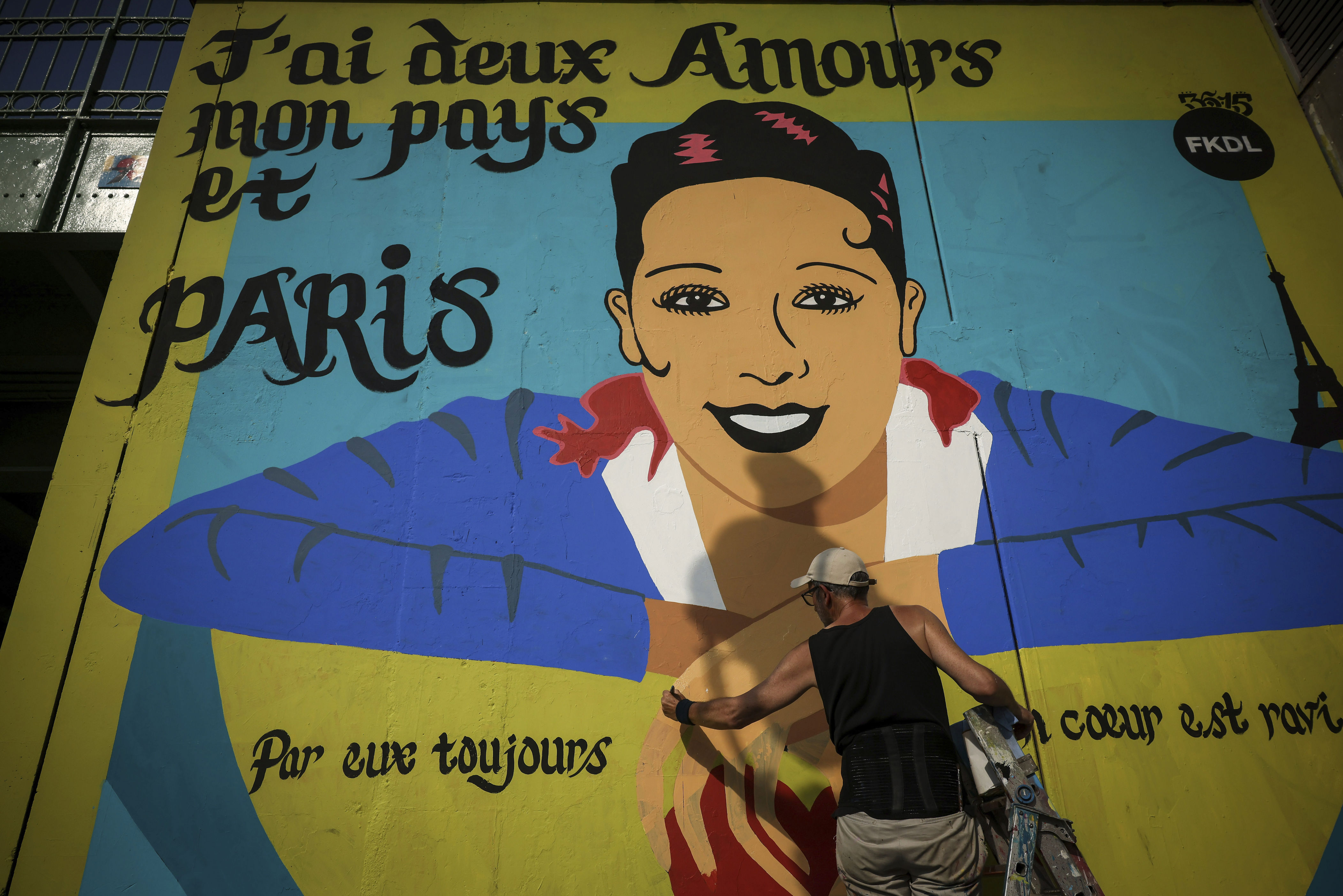
A Legacy Painted on the Walls of Paris
A vibrant mural depicting Josephine Baker, a legendary Jazz Age entertainer and civil rights advocate, now stands as a proud symbol overlooking Paris. The artwork was created by urban artist Franck Duval, known as FKDL, who emphasizes his mission to “bring women back into the urban landscape.” This mural captures Baker peering over a ledge with a warm, confident smile, while a quote from one of her songs is written in bold Gothic font: “I have two loves: my country and Paris.”
Baker’s journey began in St. Louis, Missouri, in 1906, where she faced racial discrimination from an early age. To support herself, she took on odd jobs and even performed street dances to earn money. Her talent eventually led her to join the Jones Family Band, a Black theater troupe, when she was still a teenager.
She married around this time, taking her husband’s last name, Baker, and later kept it throughout her life despite their divorce. Her career took off in New York City during the Harlem Renaissance, where she appeared in Vaudeville shows and Broadway revues. However, it was her move to Paris in 1925 that truly launched her fame. “I became famous first in France in the ’20s,” she once said. “I just couldn’t stand America, and I was one of the first colored Americans to move to Paris.”
In Paris, Baker became a sensation. Known as “the Black Venus,” her performances were highly anticipated, and she attracted the attention of renowned figures like Pablo Picasso and Ernest Hemingway. She also made history in 1927 as the first Black woman to star in a major film, Siren of the Tropics.
From an early stage, Baker was driven by a desire to help others. In her 1949 memoir, Fearless and Free, she wrote, “I promised myself that when I was strong, I would fight everyone who was mean to the poor, whether they were kings or not.” This book was recently translated from French to English for the first time.
During World War II, Baker contributed to the war effort by working as a spy for the French military. She used invisible ink on sheet music to record sensitive information while performing in front of enemy forces.
Upon returning to the United States in the 1950s, Baker became a vocal advocate for racial equality. She refused to perform for segregated audiences, and many club owners integrated their venues for her shows due to her popularity. In 1963, she spoke at the March on Washington for Jobs and Freedom, reflecting on her experiences as a Black American abroad versus in her homeland: “I do not lie to you when I tell you I have walked into the palaces of kings and queens and into the houses of presidents. But I could not walk into a hotel in America and get a cup of coffee, and that made me mad.”
Baker gave her final performance in 1975 and passed away later that year. In 2021, she received a prestigious honor in France: she was reinterred in the Panthéon monument in Paris, becoming the fifth woman and the first Black woman to be buried there.
Now, her legacy continues to be celebrated through art. The mural of Baker is part of Paris Colors Ourq, a recent street art festival. During the mural’s unveiling on July 19, Baker’s son, Brian Baker, expressed his deep emotion. He described the mural as “part of a memory of my mother” and shared how he was one of her 12 adopted children, whom she called her “rainbow tribe.”

Post a Comment for "A Vibrant Mural Honors Josephine Baker's 'Two Loves' in France"
Post a Comment