A Disastrous Star Trek Film and a Flawed Alien Sequel Share a Surprising Link
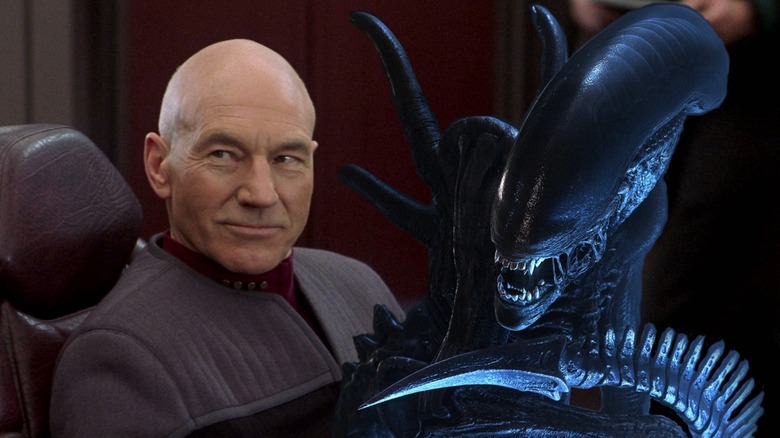
A Disappointing Chapter in Sci-Fi Franchises
When Stuart Baird's "Star Trek: Nemesis" was released in 2002, it marked a troubling moment for the Star Trek franchise. As the fourth film based on "Star Trek: The Next Generation," it was marketed as the final chapter of the series. However, what should have been a grand finale turned out to be a bleak and unexciting action film. The story centered around Captain Picard (Patrick Stewart) battling his own clone (Tom Hardy) over the fate of the Romulan Empire. There was also a subplot involving Data (Brent Spiner) discovering an unknown android brother, which allowed him to deliver two performances. This film is remembered for its bizarre scene featuring the Argo, Picard's dune buggy, which many consider one of the worst moments in Star Trek history.
The reception from fans was overwhelmingly negative. "Nemesis" only earned $67.3 million against a $60 million budget, making it the lowest-grossing Star Trek film, even when not adjusted for inflation. Post-9/11 audiences seemed less interested in a franchise focused on exploration and peace, and Trekkies were reportedly exhausted. The failure of "Nemesis" combined with the low ratings of "Star Trek: Enterprise" (2001–2005) made it seem like the franchise had reached its end.
The Writer Behind the Controversy
"Nemesis" was written by Hollywood veteran John Logan, who also contributed to the story alongside Brent Spiner and Rick Berman, a long-time leader in the Star Trek universe. Logan had already built a successful career, having written acclaimed films such as Ridley Scott’s "Gladiator" and "Any Given Sunday," as well as more questionable projects like "Bats" and "The Time Machine." His work on "Star Trek" was his first foray into a major franchise. Logan later went on to write several notable studio films, earning three Oscar nominations for "Gladiator," "The Aviator," and "Hugo."
In 2017, Logan reunited with Scott to create another controversial sci-fi film, "Alien: Covenant," the eighth installment in the "Alien" series. Like "Nemesis," "Covenant" received mixed reviews and did not meet expectations. It serves as a direct sequel to the 2012 film "Prometheus," itself a prequel to the 1979 classic "Alien." The film features Michael Fassbender as the enigmatic android David, who has been conducting genetic experiments on a distant planet. Using DNA from ancient Engineers and a mysterious biological substance, David aims to create the most efficient and beautiful life form possible.
The Impact of "Alien: Covenant"
David's experiments lead to the creation of eerie alien life forms that infect human visitors. The creatures at the beginning of the film differ slightly from those in "Prometheus" and "Alien," but by the end, a full-fledged Xenomorph appears. David becomes fixated on Walter, another android played by Fassbender. While the film was a modest success, earning $240 million on a $97 million budget, it didn’t inspire immediate follow-ups. It wasn’t until Disney acquired 20th Century Fox that another "Alien" film, "Alien: Romulus," was produced, releasing in 2024. A TV series titled "Alien: Earth" streams on FX.
A Shared Connection
John Logan co-wrote both "Nemesis" and "Alien: Covenant," raising questions about his suitability for high-profile sci-fi franchises. Interestingly, both films share a 6.4 user rating on IMDb, though this correlation may be coincidental. Despite their critical and commercial challenges, these films remain part of the broader landscape of science fiction cinema.
For those looking to stay updated on major movie and TV news, signing up for a free newsletter could be a convenient option.

Post a Comment for "A Disastrous Star Trek Film and a Flawed Alien Sequel Share a Surprising Link"
Post a Comment