The F-20 Tigershark: A Fighter Jet That Never Took Off
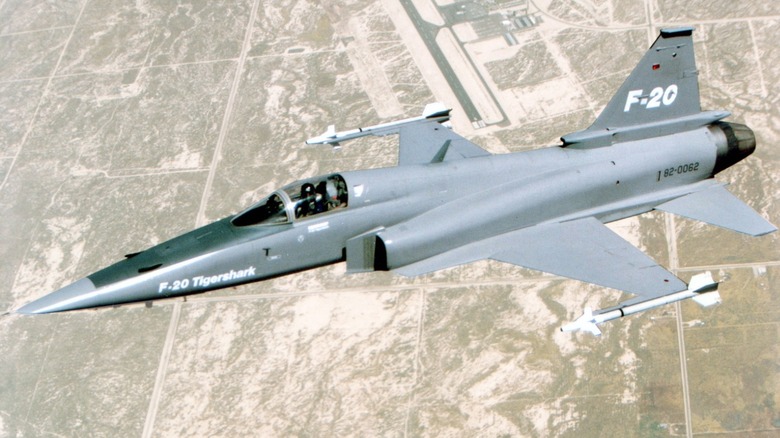
The F-20 Tigershark: A Forgotten Fighter Jet with a Tragic Legacy
When it comes to the most impressive fighter jets in the United States, many people are familiar with models like the F-22 Raptor or the F-16 Fighting Falcon. These aircraft have received significant media attention and are well-known even among those not directly involved in the military. However, one fighter jet that has largely faded from public memory is the F-20 Tigershark. This aircraft never progressed beyond the prototype stage, with only three units ever built.
The F-20 Tigershark originated from the F-X project during President Jimmy Carter's administration. The initiative aimed to develop a relatively affordable fighter capable of competing against the Soviet Union’s top aircraft at the time. The goal was for these planes to fall between the F-5E Tiger, which remains in service today, and the evolving F-16A Fighting Falcon in terms of performance. The F-X program avoided using sensitive technology, relying instead on off-the-shelf components. This approach led to the creation of the F-20, which offered impressive capabilities despite lacking more advanced features.
Originally planned for export, the F-20 would not have been used by the U.S. military if it had entered full production. However, political circumstances played a significant role in its downfall. During the Cold War, the F-20 had strong potential, but as the U.S. relaxed export controls on the F-15 and F/A-18, interest in the F-20 waned. Additionally, two test pilots lost their lives due to high-G maneuvers, further damaging the program’s reputation.
Key Features of the F-20 Tigershark
The F-20 was based on the lightweight F-5 Freedom Fighter and was constructed using cost-effective materials to counter the threat posed by Soviet MiG fighters of the era. It was powered by a single General Electric F404 turbofan engine, which produced 17,000 pounds of thrust when the afterburner was engaged. This allowed the F-20 to reach speeds of Mach 2.1 (1,560 mph) and operate at a maximum service ceiling of 55,000 feet.
The aircraft featured an advanced General Electric AN/APG-67 radar system, a cockpit heads-up display, and hands-on throttle and stick controls. Its large pressurized bubble canopy provided excellent visibility, similar to that of the F-16. In terms of armament, the F-20 was equipped with two 20mm M239A2 cannons and could carry up to 8,000 pounds of ordnance. It was also capable of firing the AIM-9 Sidewinder and AIM-7 Sparrow air-to-air missiles, as well as the AGM-65 Maverick air-to-ground missile.
Northrop developed the F-20 without an order from the U.S. Air Force, which contributed to the service's lack of interest. Despite this, the company attempted to sell the aircraft to the military, enlisting Brig. Gen. Charles "Chuck" Yeager to help persuade officials. However, the project ultimately failed due to shifting political priorities.
The Fate of the F-20 Tigershark
The operational history of the F-20 Tigershark is marked by tragedy. Two test pilots, Darrell Cornell and David Barnes, died in separate incidents involving high-G maneuvers. The first crash occurred when Cornell demonstrated the F-20 at Suwon Air Base in South Korea. Excessive G-forces caused him to lose consciousness, resulting in a fatal crash. Later, Barnes met a similar fate while preparing for the Paris Air Show, crashing in Labrador, Canada.
Although the two crashed aircraft were destroyed, the third unit survived and is now permanently displayed at the California Science Center in Los Angeles. The F-20 was mechanically sound and technologically advanced, but its development coincided with a period of political and economic shifts that ultimately led to its demise.
A Lesson in Aviation History
The F-20 Tigershark serves as a reminder of the challenges involved in developing a new fighter jet. While it was a capable aircraft, it was created at a time when other options became more attractive to both the military and international buyers. Today, it stands as a symbol of what might have been, highlighting the complex interplay of technology, politics, and timing in the world of aviation.

Post a Comment for "The F-20 Tigershark: A Fighter Jet That Never Took Off"
Post a Comment