The AI Economy's Breaking Point: When Job Loss Sparks Collapse
The AI Revolution and the Economy at a Crossroads
Artificial intelligence is no longer a distant concept—it's here, reshaping industries, disrupting jobs, and redefining the very fabric of our economy. What was once considered the domain of science fiction is now a reality that’s accelerating faster than many anticipated. As AI continues to evolve, it’s not just changing how we work; it’s altering the economic landscape in ways that could lead to significant upheaval.
The convergence of AI and the economy has created a situation where the rules are being rewritten at an unprecedented pace. On one side, AI is advancing rapidly, taking on tasks that were once thought to be exclusively human. From designing ad campaigns to diagnosing medical conditions and drafting legal documents, AI is proving its capability to perform complex functions with increasing efficiency. On the other side, the economy relies heavily on consumer income and employment. When these pillars are disrupted, the entire system can become unstable.
According to recent research and modeling, AI is projected to eliminate between 20 to 30 million American jobs by 2035. This is not just a prediction—it’s a looming reality that could trigger a cascade of economic consequences. The implications of such job losses are profound, affecting not only individuals but also the broader economic structure.
The Brute Facts: Job Losses and Economic Impact
Current U.S. payroll employment stands at approximately 160 million jobs. Each year, automation becomes more advanced and widespread, making it increasingly capable of replacing both manual labor and cognitive tasks. According to data from various institutions, including OpenAI, McKinsey, and Goldman Sachs, certain job categories are particularly vulnerable.
High-Risk Jobs (50–100% automatable in 10 years): - Administrative support: 8 million jobs, with ~6 million at risk - Customer service & call centers: 4 million jobs, with ~3.5 million at risk - Fast food & self-checkout: 5 million jobs, with ~3 million at risk - Transportation (drivers, dispatch): 4 million jobs, with ~2 million at risk
That’s already around 15 million jobs lost.
Medium-Risk Jobs (20–50% automatable): - Retail, finance, legal services, manufacturing, education - Another 8 to 12 million jobs could be displaced
Low-Risk Jobs (hard to replace): - Healthcare, skilled trades, construction - Minimal short-term impact
By 2035, the total number of jobs likely to be displaced could reach 20 to 30 million. This is not a scare tactic—it’s based on current trends, historical precedent, and technological advancements.
The Consequences of Massive Job Loss
Losing 20 to 30 million jobs would have far-reaching effects on the U.S. economy. The relationship between jobs, income, and spending is fundamental. When jobs disappear, so does income, which leads to reduced consumer demand. This, in turn, affects business revenue, which can lead to further job cuts and a downward spiral.
Economists estimate that 20 to 25% structural unemployment—equivalent to 20 to 30 million people—could push the economy into a death spiral. As mass consumer demand collapses, tax revenues shrink, debt grows, and political instability rises. The rich may continue to spend, but their consumption alone cannot sustain the economy.
The Wealth Gap Widens
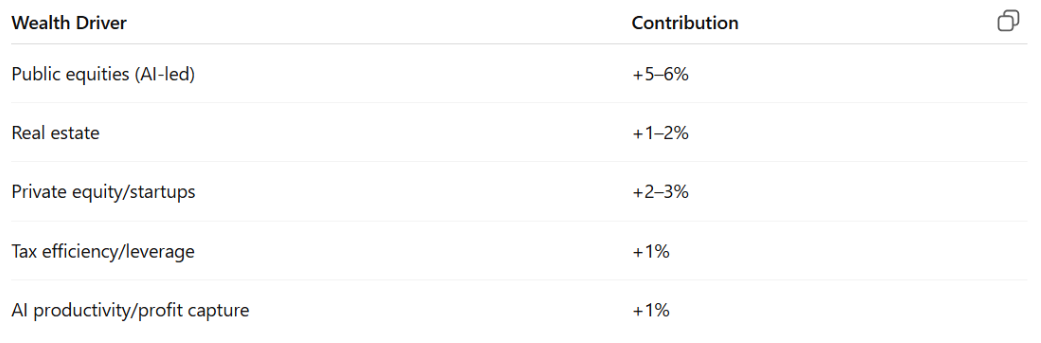
As AI eliminates middle-class jobs, the wealth gap is expected to widen dramatically. The top 10% of households own approximately 89% of all U.S. stocks. With AI-driven productivity gains, their wealth is projected to grow at a compound annual growth rate of 10%, reaching $292 trillion by 2035. Meanwhile, the bottom 90% may see their wealth shrink by 1% annually over the next decade.
This shift signals what some call a “Wealth Singularity”—a point where capital ownership dictates economic power. The rich will control the AI infrastructure, while the working class loses influence. This dynamic could lead to social unrest, political instability, and eventually, major structural reforms or economic collapse.
Investing in the AI Economy
In this evolving landscape, the key to financial survival lies in investing in the AI economy. Rather than focusing on traditional tech stocks, investors should look for companies that own the foundational platforms, infrastructure, and tools behind the AI revolution.
Some of the most promising companies include: - Foundational AI companies: Nvidia, AMD, Broadcom, Marvell - Applied AI and robotics firms: Tesla, Palantir, UiPath, Symbotic - AI infrastructure plays: Arista Networks, MP Materials, Constellation, Cisco, Oracle
These companies are positioned to capture productivity gains and generate long-term value, regardless of job losses.
Preparing for the Future
With AI steering the economy toward a new era, it’s essential to adapt and prepare. While the future may seem uncertain, there are opportunities for those who understand the shifts happening in the market. By aligning investments with the AI economy, individuals can position themselves to thrive in the coming years.

Post a Comment for "The AI Economy's Breaking Point: When Job Loss Sparks Collapse"
Post a Comment