Thai and Cambodian Leaders Converge in Malaysia to Resolve Border Conflict
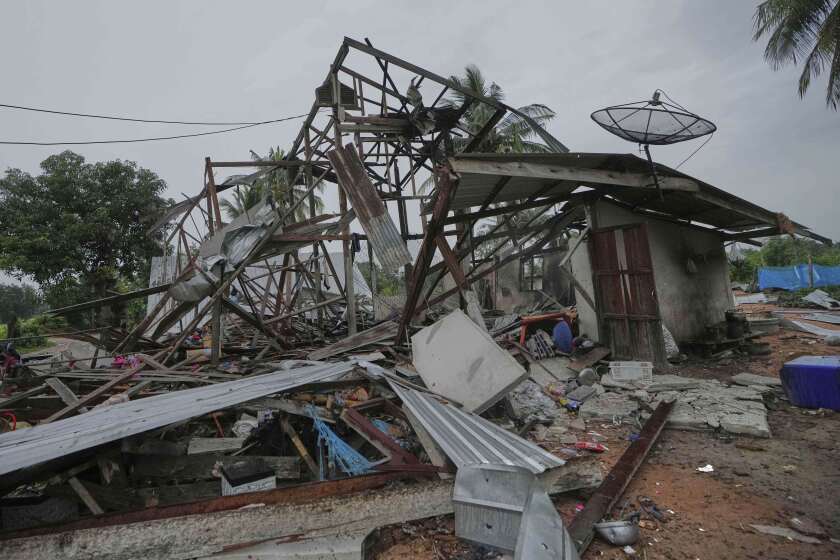
Thai and Cambodian Leaders Prepare for Talks in Malaysia to Resolve Border Conflict
Thai and Cambodian leaders are set to meet in Malaysia for discussions aimed at ending the ongoing border conflict, according to a statement from the Thai prime minister’s office. This meeting follows pressure from U.S. President Donald Trump to resolve a deadly dispute that has claimed at least 34 lives and displaced over 168,000 people.
Acting Prime Minister Phumtham Wechayachai is expected to attend the talks on Monday, following an invitation from Malaysian Prime Minister Anwar Ibrahim. The talks will take place under the auspices of ASEAN, with Anwar serving as the organization’s chair. It is also reported that Hun Manet, the Cambodian leader, will be present, although this has not yet been officially confirmed by the Cambodian government.
Pressure from the U.S. and Calls for Ceasefire
President Trump has taken a direct role in the conflict, urging both nations to halt hostilities. He threatened to delay trade agreements with Thailand and Cambodia if the violence continued. However, he later stated that both sides had agreed to negotiate a ceasefire.
Hun Manet announced that Cambodia is pursuing an “immediate and unconditional ceasefire.” He said that Thailand had also agreed to stop attacks after his conversation with Trump. He tasked his foreign minister, Prak Sokhonn, with coordinating with U.S. Secretary of State Marco Rubio and engaging directly with Thailand’s foreign minister to implement the ceasefire.
Thailand has expressed cautious support for the move, with Phumtham thanking Trump and agreeing in principle to a ceasefire. However, the Thai Foreign Ministry emphasized the need for “sincere intention” from Cambodia and called for swift bilateral talks to address the situation.
Continued Fighting and Mutual Blame
Despite diplomatic efforts, fighting has continued along parts of the contested border. Both sides have accused each other of starting the conflict. Thailand closed its border crossings with Cambodia, and both countries recalled their ambassadors.
Colonel Richa Suksowanont, a Thai army deputy spokesperson, reported that Cambodian forces fired heavy artillery into Surin province, including at civilian homes. He also claimed that Cambodia launched rocket attacks targeting the Ta Muen Thom temple, a site claimed by both countries. In response, Thai forces used long-range artillery to strike Cambodian positions.
The Thai Foreign Ministry criticized Cambodia for lacking good faith and violating human rights principles. Meanwhile, Cambodian Defense Ministry spokesperson Lt. Gen. Maly Socheata accused Thai forces of escalating the violence with bombardments and a “large-scale incursion” involving tanks and ground troops.
Human Toll and Evacuations
The conflict has resulted in additional casualties, with Thailand reporting a new death, bringing the total to 21, mostly civilians. Cambodia reported 13 deaths. Over 131,000 people in Thailand have evacuated to safer locations, while more than 37,000 people from three Cambodian provinces have fled. Many border villages are deserted, with schools and hospitals shut down.
Evacuees like Pichayut Surasit, an air-conditioning technician, have returned home to protect their families. He is staying in a shelter in Surin with thousands of others, hoping for a swift resolution. Similarly, local vendor Bualee Chanduang is praying for peace and for both sides to reach an agreement.
International Response and Historical Context
Pope Leo XIV expressed concern for those affected by the conflict, particularly children and displaced families. The United Nations Security Council has urged ASEAN to mediate between Thailand and Cambodia. Human Rights Watch has condemned the use of cluster munitions in populated areas, calling for both governments to protect civilians.
The 500-mile border between Thailand and Cambodia has been disputed for decades, but previous clashes were limited and brief. Tensions escalated in May when a Cambodian soldier was killed in a confrontation, leading to a diplomatic rift and domestic political unrest in Thailand.
This report was written by Saksornchai and Cheang for the Associated Press, with contributions from Chalida Ekvitthayavechnukul, Grant Peck, and Eileen Ng.

Post a Comment for "Thai and Cambodian Leaders Converge in Malaysia to Resolve Border Conflict"
Post a Comment