Signpost: The Synthetic Puppeteer Targets Business
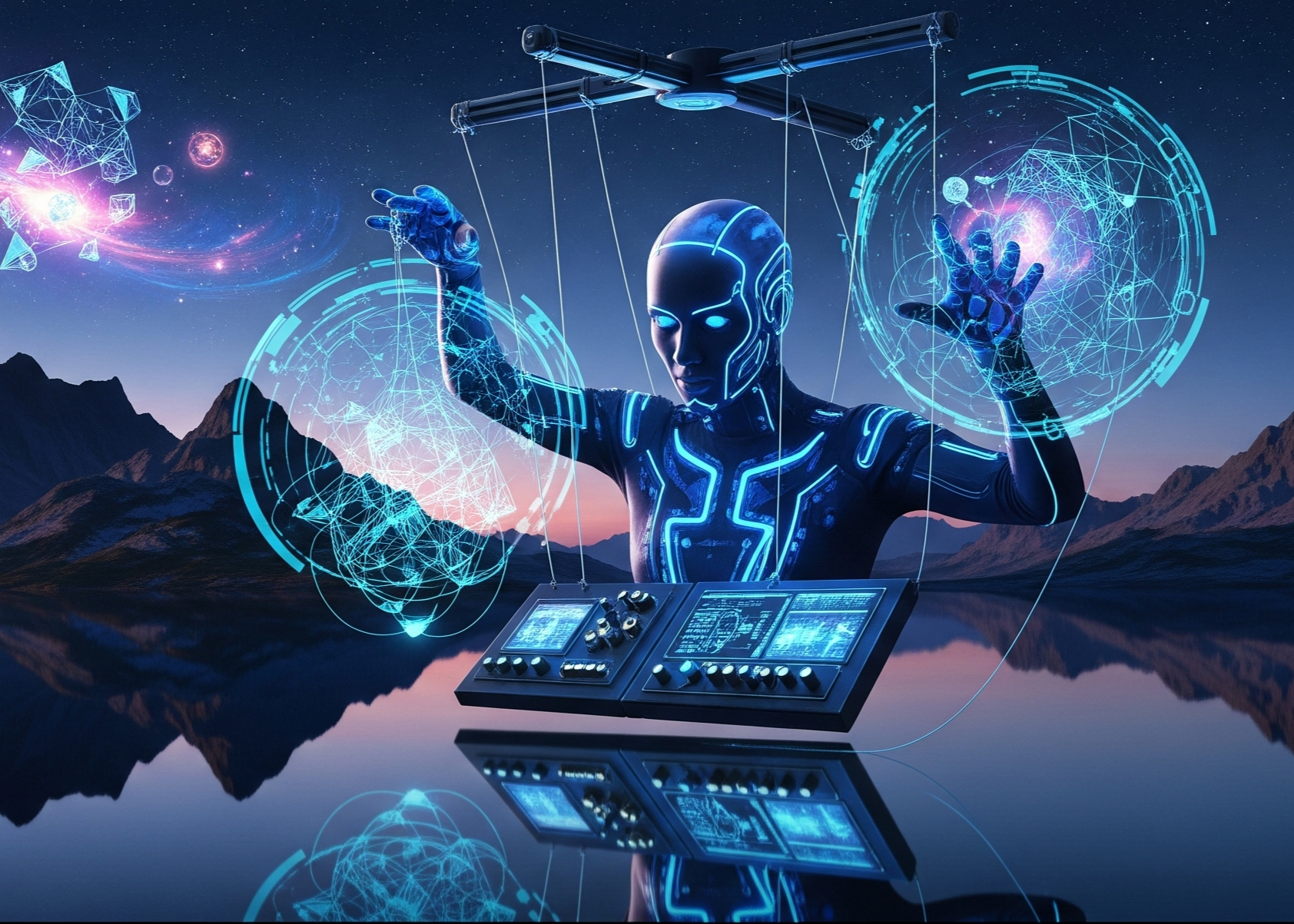
The Rise of Synthetic Media and Its Impact on Business, Politics, and Society
The most transformative shift in influence across business, politics, and media began with a celebrity face in a video that no one ever filmed. This face looked real, the voice sounded right, but the clip was entirely fabricated—created using artificial intelligence to mimic a person who never spoke those words. This moment marked the introduction of synthetic media: content generated or altered by AI to appear authentic across various formats such as video, audio, images, and text.
Nina Schick, former advisor to NATO on election interference, founding member of the Qlik AI Council, and author of the 2020 book Deepfakes: The Coming Infocalypse, recalls her first encounter with this phenomenon. “I had the ChatGPT moment in 2017 when I first saw a deep fake,” she says. “That was really the moment I realized it. This was the very first viral case of so-called generative AI.”
Over the previous decade, Schick worked closely with global leaders on managing digital threats to democracy. By 2017, her focus had already shifted to the role of technology in shaping public perception. Deepfakes revealed to her that AI would not only analyze information but also produce it. And not just at scale, but at an individual level.
“The very first iteration of our new relationship with AI’s expanding capabilities was in the form of AI-generated content,” she explains. “Which then became generative AI, which then became ChatGPT, which is now agentic AI.” This rapid evolution pushed synthetic media into the business mainstream. Companies now use digital avatars in marketing, automate customer engagement with humanlike voices, and generate custom video and copy in real time. Across industries, AI is being used both to streamline operations and to deepen audience engagement.
“Humans love stories,” says Schick. “That goes all the way back to the birth of civilization.” But now, the storytellers include algorithms that adapt to context, preference, and emotion. “Anyone can engage with content specifically made for them,” she adds.
This shift has profound implications for how businesses communicate and how consumers respond. A campaign crafted by a synthetic team can run 24/7 across every language and market. Every customer interaction becomes a personalized experience. This technology unlocks immense commercial potential. Brands can speak to customers in their language, and sales teams can automate outreach at a human scale. But this power also creates new demands around credibility and accountability.
“Do you even understand what truth is if you’re essentially living in a simulation?” Schick asks. In a media environment shaped by AI, the burden shifts from proving facts to maintaining trust. “The license to operate has to somehow be based on trust rather than truth,” she says.
This introduces a new frontier in compliance and digital governance. At the infrastructure level, synthetic influence feeds into a much larger contest. “We are entering an era of a new geopolitical order,” says Schick. AI infrastructure—including compute capacity and energy supply—now defines strategic advantage. Countries with access to these assets control the future of scientific research and economic growth.
This race is not limited to global superpowers. Markets across Africa, Asia, and Latin America hold immense potential as partners and producers in this new era. Schick believes that even without vast infrastructure, high-impact innovation can emerge from anywhere. “If you can’t build the infrastructure,” she says, “the next smart play is to build on top of the compute.”
That opportunity extends to local entrepreneurs and research institutions. Synthetic media offers a low-friction toolset for building brands and scaling presence. The challenge lies in applying these tools responsibly, with clarity about origin and intention.
“What you’re starting to see in Silicon Valley is the birth of an entirely new type of company,” she says. “These firms are not improving existing processes, but rethinking industries from first principles, using AI to define the model from day one. Synthetic communication becomes the interface.”
Influence, in this context, becomes a strategic asset. The ability to generate persuasive content and shape public perception at scale delivers a new form of leverage. The same synthetic media that first went viral through a fake celebrity video now drives both corporate branding and geopolitical positioning.
As Schick puts it, “Ultimately, it’s about power.”

Post a Comment for "Signpost: The Synthetic Puppeteer Targets Business"
Post a Comment