Sculptor Galaxy Image Reveals Star-Formation Secrets
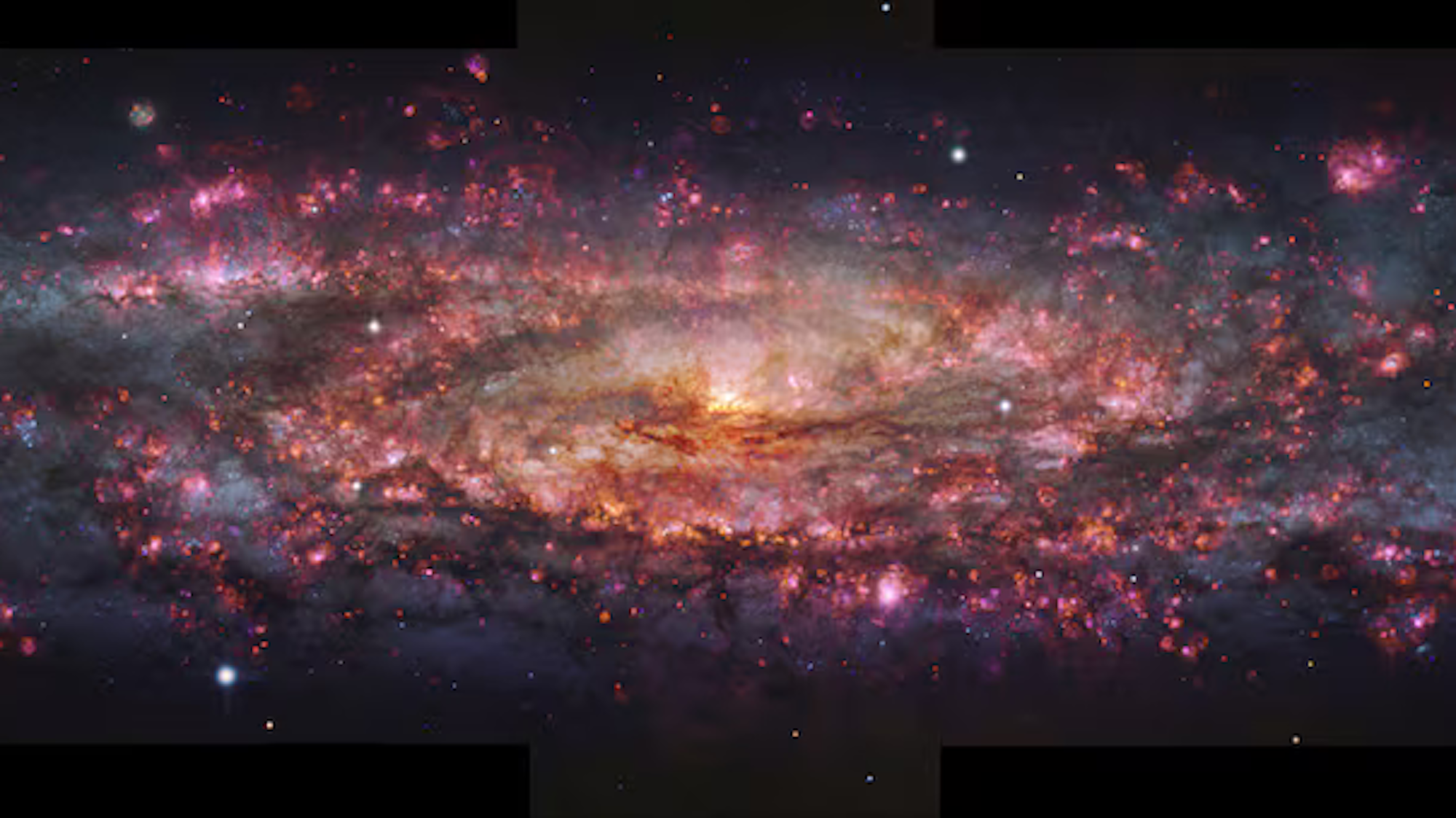
A Glimpse into the Sculptor Galaxy
If you find yourself in the Southern Hemisphere on a clear summer night, you might just catch a glimpse of the Sculptor galaxy through binoculars. With a keen eye and patience, you could even recreate one of the most detailed images of this nearby galaxy. This image isn’t just visually stunning—it’s a rich source of scientific data that astronomers are eager to explore.
As an astronomy Ph.D. student at Ohio State University, I (Rebecca) spend hours analyzing this image alongside my adviser, Adam. We’re uncovering the secrets hidden within the beauty that everyone can appreciate.
How the Image Was Created
The Sculptor galaxy is located 11 million light-years away from the Milky Way, making it one of the closest galaxies to Earth. Due to its proximity, it has been a key target for many astronomical observations. In 2022, an international team of scientists used the Multi-Unit Spectroscopic Explorer (MUSE), mounted on the European Southern Observatory’s Very Large Telescope in Chile, to observe the Sculptor galaxy. The data was publicly released in June, offering a new perspective on this celestial object.
Most astronomical observations capture either a single color image or a spectrum that splits light into different colors. However, MUSE does both, producing a spectrum at every point it observes. This allows scientists to create thousands of images in various colors, each revealing important components of the galaxy—stars, dust, and gas.
The final image of the Sculptor galaxy is not just one picture. It combines over 100 individual observations and 8 million spectra, painstakingly stitched together to show millions of stars forming a cohesive galaxy.
Scientific Significance
In the image, the light from stars appears white, while gas made up of charged particles is shown in red. These elements are concentrated in the spiral arms of the galaxy. At the center lies a nuclear starburst—a region of intense star formation that is expelling material out of the galaxy.
Even the absence of light holds value. Dust blocks light from behind it, creating dark regions known as dust lanes. By tracing these lanes, scientists can identify cold, dense material between stars, which is believed to be the fuel for future star formation.
One of the most intriguing aspects of the image is the red glow from gas in star-forming regions. Here, young and massive stars excite the surrounding gas, causing it to emit light. This glow reveals the chemical composition and physical conditions of the gas.
This image marks one of the first times astronomers have captured thousands of star-forming regions with such detail. Our team uses MUSE data to study how these regions are structured and how they interact with their surroundings.
By piecing together all this information, astronomers gain insights into the formation and evolution of stars across the universe. This research helps us understand the broader processes that shape galaxies and the cosmos itself.

Post a Comment for "Sculptor Galaxy Image Reveals Star-Formation Secrets"
Post a Comment