Largest Cosmic Explosion Since the Big Bang Unveils Gamma-Ray Burst Secrets
Understanding the Brightest Gamma-Ray Burst
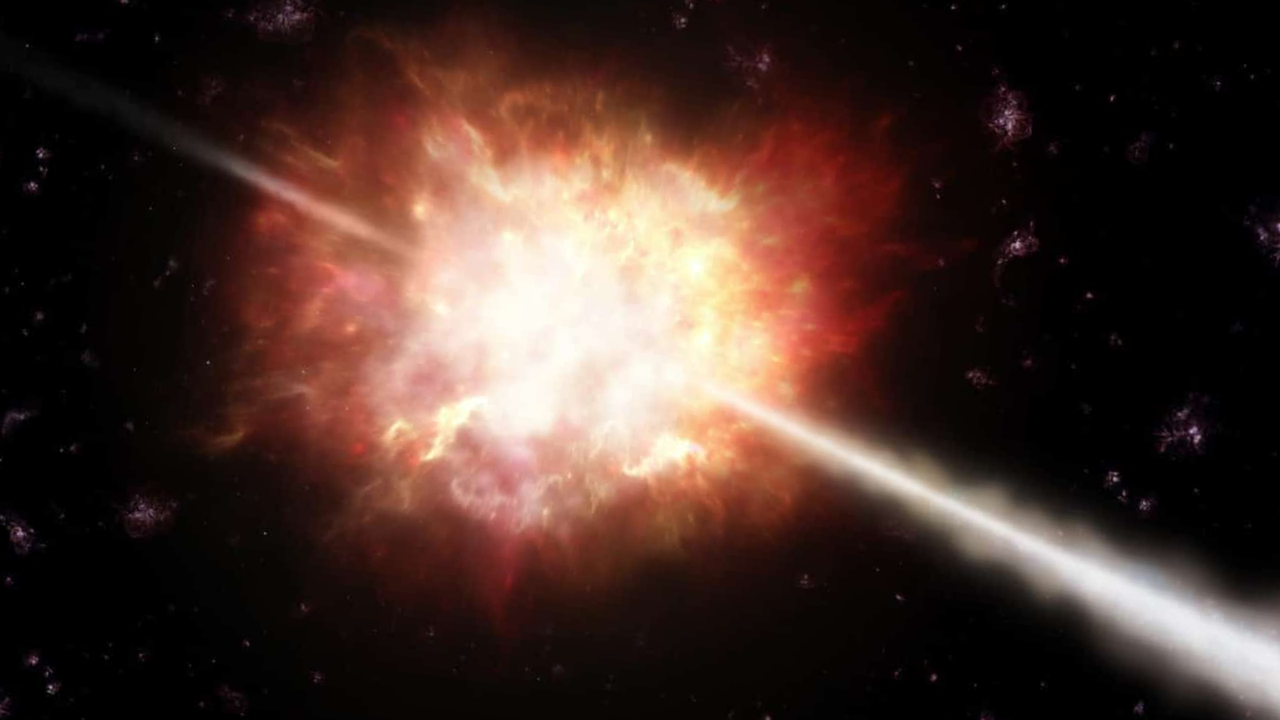
Astronomers have taken a closer look at what is considered the most powerful explosion ever recorded, potentially the largest since the Big Bang. This event, known as the "Brightest Of All Time" (BOAT) or GRB 221009A, has provided new insights into gamma-ray bursts (GRBs), which are high-energy explosions that remain one of the most mysterious phenomena in the universe.
The BOAT is the most intense GRB ever detected. To put this into perspective, a typical GRB can release as much energy in seconds as the Sun will emit over its entire 10 billion-year lifespan. Despite their immense power and brightness, GRBs are notoriously difficult to trace back to their origins. Scientists still struggle to fully understand where these events come from, even though they are believed to originate outside the Milky Way galaxy.
As the gamma-ray signal from a GRB travels across vast cosmic distances, it weakens significantly. These bursts typically consist of a brief, intense flash lasting just seconds to minutes, followed by an afterglow that can persist for hours or even months. GRBs are divided into two main categories based on their duration: long-duration and short-duration bursts.
Long-period GRBs last more than two seconds and are thought to occur when massive stars end their lives in supernova explosions, leaving behind black holes. Short GRBs, on the other hand, last less than two seconds and are believed to result from the collision and merging of neutron stars.
The BOAT is particularly significant because it is thought to have originated from a massive star located about 2.4 million light-years away. As the star reached the end of its life, it exploded in a supernova, creating a stellar-mass black hole. The detection of an excess in the gamma-ray flux of the BOAT suggests that these explosions may involve complex structures, such as multi-layered jets that accelerate particles to extreme energies.
Tracking the BOAT
The BOAT was first observed on October 9, 2022, by several telescopes, including NASA’s Fermi and Swift observatories. Its extraordinary brightness immediately set it apart from other GRBs. While the initial flash of gamma rays was detected, the afterglow that followed allowed non-gamma-ray telescopes to study the event across multiple wavelengths of light.
Researchers used the Large-Sized Telescope (LST) prototype (LST-1) at the Roque de los Muchachos Observatory in La Palma, Spain, to track the BOAT. The LST-1 began observing the event approximately one day and eight hours after the initial detection, despite challenging conditions caused by a full moon. Over the next 20 days, the team gathered data that helped place constraints on the upper limits of high-energy gamma-rays emitted by the blast.
These observations could help distinguish between different models of how GRBs are formed. Whether generated by colliding neutron stars or the collapse of massive stars, GRBs are thought to involve the ejection of a high-speed jet of plasma. However, the exact structure of these jets remains unclear.
The LST-1 observations suggest that the BOAT was powered by a layered jet, with a fast-moving central cone surrounded by slower-moving material. This challenges existing models that describe jets as having a top-hat shape, with lower-energy particles forming the outer rim. The findings also offer clues about the central engine responsible for driving these jets.
Future Prospects for High-Energy Astronomy
The research on the BOAT highlights the potential of advanced telescopes like the LST to study the high-energy universe. Three additional LST instruments are currently being developed at the same site as LST-1, and similar telescopes are being constructed in Chile. This will soon create arrays of telescopes operating in both the northern and southern hemispheres, greatly enhancing our ability to detect and study GRBs.
This improved observational capacity will not only deepen our understanding of these cosmic explosions but also reduce the time it takes to alert astronomers to transient events. The study was published on July 23 in The Astrophysical Journal Letters, offering new insights into one of the most energetic phenomena in the universe.

Post a Comment for "Largest Cosmic Explosion Since the Big Bang Unveils Gamma-Ray Burst Secrets"
Post a Comment