"I Saw Something Different": IDF Reservist Denies International Claims of Intentional Starvation
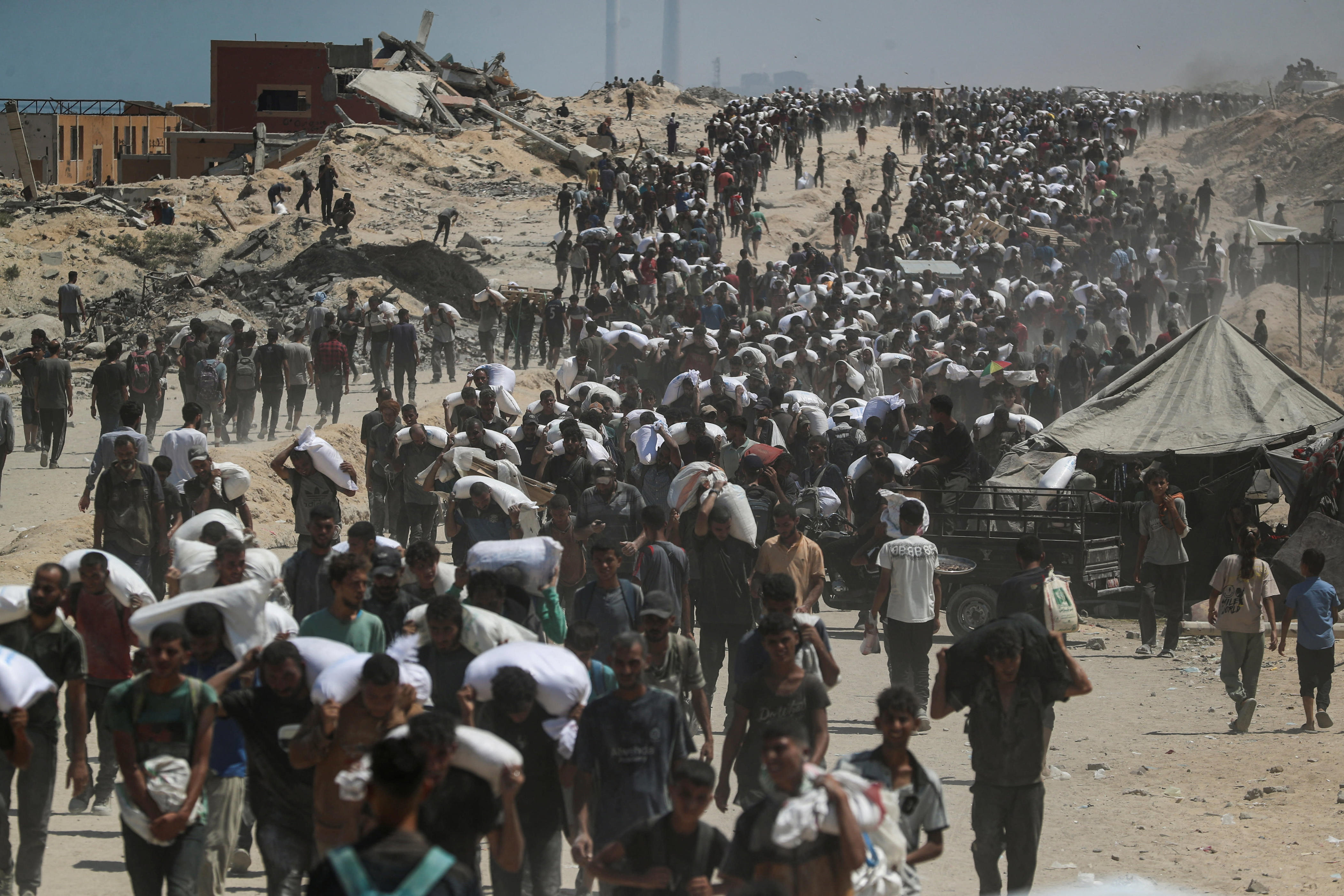
The Soldier’s Account: A Glimpse into the Chaos of Gaza
In the quiet outskirts of Tel Aviv, an active-duty soldier in the Israel Defense Forces (IDF), who has chosen to remain anonymous for security reasons, is between rounds of duty after completing over 300 days of service since October 7. In a detailed account shared with an independent outlet, he recounts one of the most contested incidents of the war, challenging headlines that claimed Israeli soldiers opened fire on starving civilians.
Another IDF reservist who was present at the scene also confirmed the soldier’s story, including the sequence of events and the nature of the crowd that approached the aid distribution site. Access to Gaza remains limited, and foreign press has struggled to enter the area to tell the story accurately. As a result, the narrative surrounding the humanitarian situation in Gaza often lacks firsthand insight from those on the ground.
The Conflict Over Aid Distribution
The issue of food distribution in Gaza has become a focal point of international debate. While some reports suggest widespread starvation, the Coordinator of Government Activities in the Territories (COGAT) has challenged these claims, stating, “There is no famine in the Gaza Strip,” while acknowledging “issues of access to food” in certain areas. Photos circulating on social media have shown thousands of humanitarian aid trucks stalled outside the Gaza Strip, raising questions about the efficiency of aid delivery.
According to Col. Abdullah Halabi of COGAT, Israel allows the entry of humanitarian aid beyond the standards of international law, without restriction. However, the UN has accused Israel of bureaucratic hurdles preventing aid from reaching civilians. Despite this, the IDF has announced plans to resume airdrops of aid into Gaza, coordinated by COGAT and the Israeli air force. This effort will include seven aid pallets containing flour, sugar, and canned food provided by international organizations. Additionally, the IDF said it will facilitate the movement of aid trucks within Gaza.
The Humanitarian Corridor: A Controversial Effort
The soldier, referred to as “Y,” was assigned to a humanitarian corridor intended to deliver aid to civilians in Gaza. He described the experience as one of the most difficult tasks he has faced. “We’re not trained for that. We’re infantry. We’re supposed to fight terrorists, not manage riots.”
The corridor, part of three Safe Distribution Sites in southern Gaza, was designed to allow aid trucks into the Strip without empowering Hamas. It was coordinated with U.S. aid officials and monitored by drones to weaken Hamas’s control over food distribution and pressure the group to agree to a ceasefire and release hostages. “It made sense strategically,” he explained, “but on the ground, it turned into chaos.”
Thousands of civilians poured into the compound daily, which was the size of a football field, surrounded by sand berms and barbed wire. People arrived on foot, in cars, motorcycles, or even horses. There were no lines, no supervision, just a stampede. “They push, they stab, they throw sand at each other. Sometimes they trample the weak,” he said.
The Incident That Shook the Corridor
On July 19, around 10 p.m., eight to ten aid trucks arrived at the site. The delivery was standard procedure, meant to prepare for morning distribution. But soon after, a crowd began to approach. “They weren’t supposed to be there. It was closed. They saw the trucks and came to loot,” he said. “We fired warning shots. No one was hurt. They left, for the time being.”
Around 2 a.m., a small team was sent to a forward position one kilometer from the corridor. Their role was to intercept any suspicious movement before it reached the aid zone. At approximately 4:30 a.m., four Gazan men came into view. Voices echoed in the dark. Then came chants of “Allahu Akbar.” “That’s when it became obvious; this wasn’t just a spontaneous crowd,” he said. “It was coordinated.”
The four Gazan men emerged from behind a building. A warning shot was fired ten meters in front of them. They kept running. “Then four became a hundred. Then a thousand. All adult men. No women. No children. Just men running straight at us.”
With the mass approaching within 100 meters, a standing order was given: defend the position. “Nothing stopped them, not the drones, not the megaphones, not flash grenades or warning shots. In the end, we fired. There was no other choice.”
The Aftermath and the International Narrative
The incident led to international headlines claiming that Israeli troops had opened fire on civilians waiting for food. “Y” says he was there and that nothing about that morning resembled the story broadcast to the world. According to his account, the event was not a line for food but a violent attempt to overrun the corridor.
Telegram channels later published the names of the dead. “All adult males. No women. No children.” The soldiers held their positions for over thirty minutes. At one point, a small force was actively defending the rooftop. “If they had broken through, we would’ve been overrun. There was no alternative.”
What angers him most is how quickly the story was rewritten. “By midday, headlines were saying we shot starving civilians. That’s not what happened. It wasn’t a line for food. It was a violent attempt to overrun the corridor.”
A Call for Ceasefire and Accountability
“Y” believes the entire event was staged. “They wanted a bloodbath. Something to sell to the media. And they got it.” On the proposal to restore distribution control to UNRWA, his response is blunt: “UNRWA is Hamas. There’s no difference between them. Giving them back control is handing it straight to the terrorists.”
For “Y,” the only path to end the current cycle is a ceasefire and hostage return. “But that can’t mean full withdrawal. There has to be a buffer zone. We can’t allow another October 7.”
He doesn’t expect the headlines to change. “The lies will continue. The world will keep blaming us. But we’ll keep doing the job, because someone has to.” Then, without raising his voice, he adds: “They weren’t hungry. They were coming for the trucks.”

Post a Comment for ""I Saw Something Different": IDF Reservist Denies International Claims of Intentional Starvation"
Post a Comment