Human Rights Groups Rally Against Mass Layoffs in Argentina
A Legacy of Trauma and Resistance
On the grounds of a former naval academy in a Buenos Aires neighborhood, a pearl gray Skyvan PA-51 sits parked on a concrete walkway. At first glance, it appears to be an ordinary plane. However, between 1976 and 1983, this aircraft was used as an instrument of murder by Argentina's military dictatorship. During this dark period, up to 30,000 people are believed to have been "disappeared," or murdered. Anyone deemed an enemy of the state could be ordered aboard the Skyvan for a "death flight"—a journey over the Atlantic Ocean where they would be pushed out at 10,000 feet.
For years, the planes used in these atrocities were thought to still exist but had never been found. However, an Argentine journalist named Miriam Lewin uncovered one such aircraft and decoded its flight logs, revealing the round trips that took victims out to sea. Using these logs, she discovered the fate of 12 women, including two French nuns, who had been taken during December 1977. Their deaths were confirmed through these records.
In a 60 Minutes interview, correspondent Jon Wertheim asked Lewin why the military would resort to such a cruel method of murder. She explained, “Death flights allowed them to disappear the bodies of the disappeared. No trail, no clues whatsoever that could incriminate them.”
The Systematic Erasure of Identity
Argentina’s military regime also engaged in another inhumane practice: the abduction of babies from pregnant mothers held in captivity. These infants were given to military families seeking to adopt. Guillermo Pérez Roisinblit, who was separated from his biological mother while she was detained, was raised by a family with military connections. When he learned the truth, it was a deeply confusing and isolating experience. “It’s like all the ties you have at that moment are cut and you’re absolutely alone,” he said.
The former naval academy, La Escuela de Mecánica de la Armada (ESMA), served as a detention and torture facility during the dictatorship. Lewin herself was once held there. Through processes focused on Truth, Memory, and Justice, ESMA was transformed into a museum and became a hub for human rights organizations and government agencies that document and educate about the regime’s crimes. In September 2023, ESMA was declared a UNESCO World Heritage Site.
Preserving the Past, Fighting for the Future
The National Archive of Remembrance, located at ESMA, houses primary source documents related to the dictatorship and serves as a critical resource for criminal prosecutions. It is also home to the Madres de Plaza de Mayo and Abuelas de Plaza de Mayo—human rights organizations led by the mothers and grandmothers of those who were disappeared. The Abuelas use DNA testing to identify stolen children from the era, having found 139 so far and estimating hundreds more remain missing.
Estela de Carlotto, president of the Abuelas de Plaza de Mayo, spent decades searching for her grandson. Her daughter, Laura, gave birth to him in captivity before being killed. Carlotto emphasized the importance of government subsidies for their work, which have been threatened under the current administration.
A New Era of Cuts and Uncertainty
President Javier Milei has campaigned on austerity measures, leading to significant budget cuts. Starting in December, human rights workers in government agencies, museums, and investigative organizations were laid off. According to a union representative, roughly half of the workers in the Human Rights Secretariat were affected. At the National Archive for Remembrance, half of the investigative staff was let go, leaving only a few employees for document conservation and digitization.
State agencies, including the Central Registry for Victims of State Terrorism and the National Identity Commission (CONADI), saw staff reductions. Even the Haroldo Conti Cultural Center, which promotes human rights through the visual arts, was shuttered indefinitely for "restructuring."
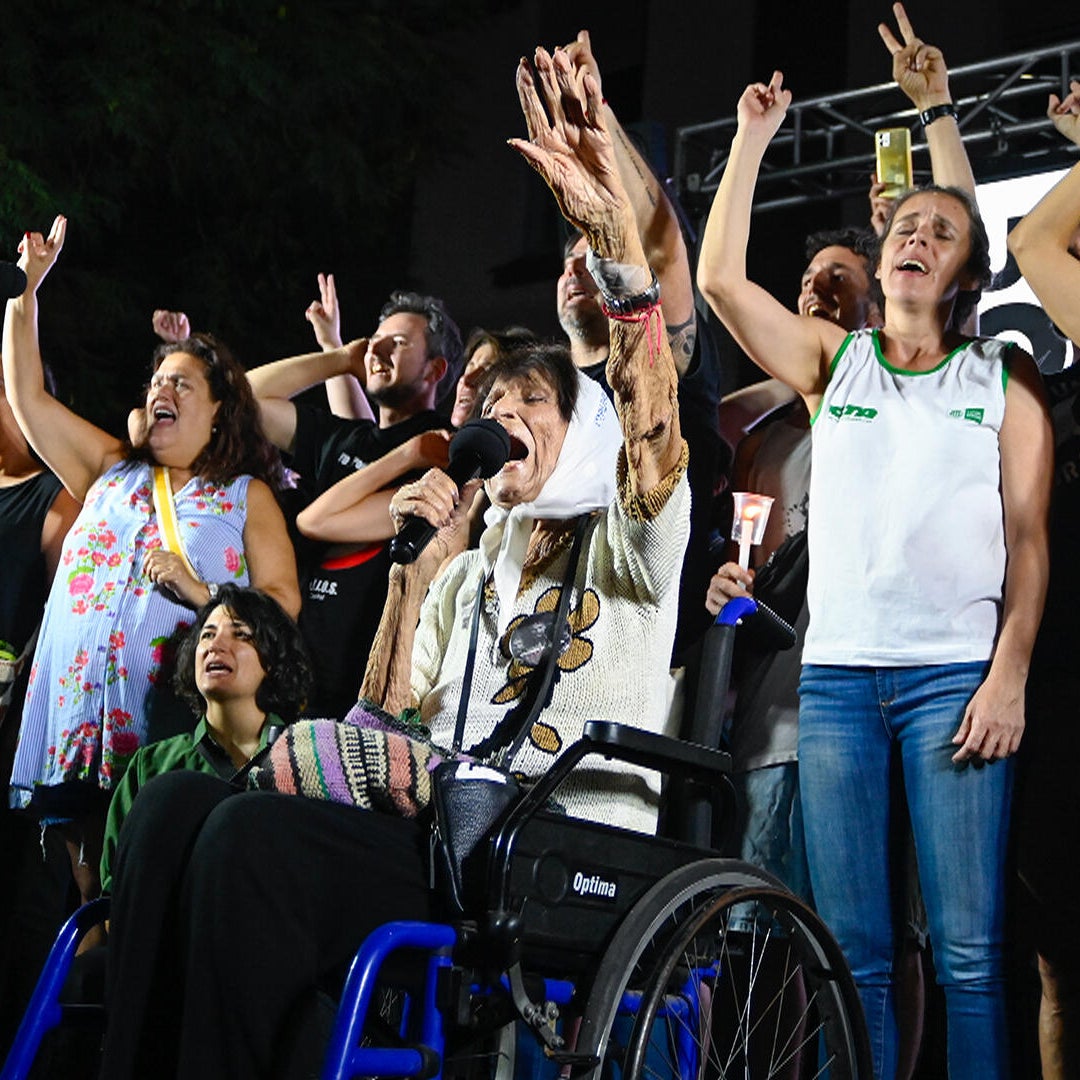
Thousands of protestors gathered at ESMA in January to protest the layoffs and the closure of the cultural center. Among them was Miriam Lewin, who described the event as emotionally powerful. “We had this huge rally with lots of young people, musicians, dancers, writers, poets, and survivors,” she said. “It was very moving to see the crowds surrounding the Skyvan, which stands as a symbol of state terrorism.”
A Struggle for Survival
The Abuelas de Plaza de Mayo have not received any subsidies from the Milei government, and their questions about funding remain unanswered. In early January, Justice Minister Mariano Cúneo Libarona wrote on X that he had cut off all government funding to the Abuelas, calling them a “con.” Despite repeated inquiries, neither Libarona nor former Human Rights Secretariat Alberto Baños responded to questions about the layoffs.
The Milei government has continued to reduce funding and lay off workers in recent months. In April, the Ministry of Justice cut funds designated for ESMA, citing the need for an audit and suspending payments until there is transparent accounting. In May, the Human Rights Secretariat was downgraded to an undersecretariat, resulting in a 30% reduction in staff. Earlier this month, the executive director of the Museum and Site of Memory at ESMA, Mayki Gorosito, was fired.
Lewin expressed deep concern about the ongoing policies. “If I could talk to President Milei and Vice President Villarruel, I would ask them to stop this policy of destruction,” she said. “We have grandmothers looking for their grandchildren. I would ask them for empathy… please, have some empathy.”

Post a Comment for "Human Rights Groups Rally Against Mass Layoffs in Argentina"
Post a Comment