Earth's Water Was Born, No Delivery Needed
Understanding Earth's Water Origins
Earth is unique among known planets in that it has vast oceans, lakes, and extensive river systems. Water is essential for life as we know it, and without it, Earth would be a barren, lifeless world. Scientists have long been fascinated by how Earth came to have so much water. The prevailing theory has been the "late veneer hypothesis," which suggests that water was delivered to Earth after its core had formed, likely through comets, asteroids, or meteorites. However, recent research challenges this view.
The Snowline Hypothesis
For many years, scientists believed that Earth's water originated from beyond the snowline—a boundary in the early solar system where temperatures were low enough for water vapor to condense into ice. This line separated regions where water could exist as ice from those where it would sublimate (turn directly from solid to gas). According to the late veneer hypothesis, water-rich bodies like comets and asteroids delivered water to Earth after the planet had already formed.
But new findings suggest that the snowline may not be as clear-cut as previously thought. A recent study published in The Astrophysical Journal Letters explores the idea that water may have been present in the inner solar system from the beginning, rather than being imported from the outer regions.
New Insights from Quantum Chemistry
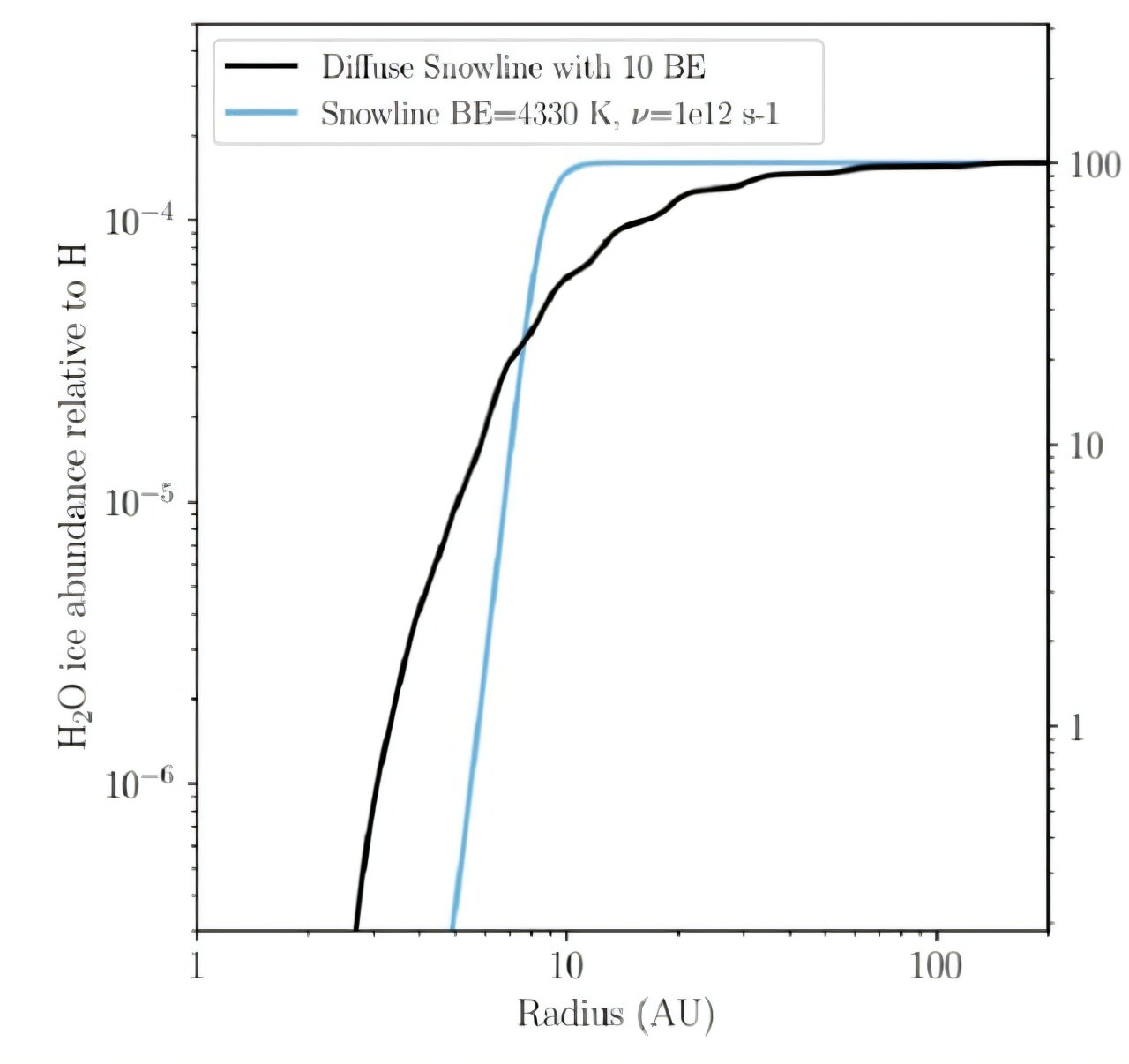
The research, led by Lise Boitard-Crépeau from the University of Grenoble Alpes in France, uses advances in quantum chemistry to show that the binding energy of water on dust grains varies. Instead of a single temperature at which water binds to these grains, there is a distribution of energies, leading to a more gradual process of sublimation rather than a sharp transition.
This means that water could have remained attached to dust grains even within the region traditionally considered the snowline. The researchers found that while most water ice is desorbed beyond about one astronomical unit (the distance between Earth and the Sun), small amounts can still remain attached to dust grains inside that limit due to varying binding energies.
Implications for Earth's Water Content
The study shows that this small fraction of water—between 0.04% and 2.5%—could fully account for Earth's total water content. This suggests that Earth's water may have been inherited locally from icy dust grains in its orbit, rather than being delivered from the outer solar system.
Furthermore, the model successfully reproduces the observed water-equivalent content in chondrites, a type of meteorite that has remained largely unchanged since the formation of the solar system. These meteorites provide important clues about the early solar system and the materials that contributed to Earth's formation.
Enstatite Chondrites and Isotopic Ratios
One key finding is that Enstatite Chondrites (ECs), a rare type of meteorite, may have formed near Earth's orbit. They share a similar isotopic ratio with Earth's water, supporting the idea that Earth's water originated locally. This aligns with the notion that ECs are the building blocks of our planet.
Challenges and Future Research
While the new model offers a compelling alternative to the late veneer hypothesis, some challenges remain. For example, the current measured ratio of heavy water (deuterium) to regular water may not reflect the original elemental ratio due to processes that cycle water between Earth's surface and interior.
Despite these uncertainties, the research provides strong evidence that a significant portion of Earth's water may have originated locally, without the need for delivery from beyond the classical snowline. If further studies support these findings, the traditional view of Earth's water origins will be significantly revised.
Conclusion
This research opens up new possibilities for understanding how Earth became a water-rich planet. It challenges long-held assumptions and offers a fresh perspective on the role of local processes in shaping our planet. As scientists continue to explore these ideas, our understanding of Earth's history—and the origins of life itself—will become even more nuanced.

Post a Comment for "Earth's Water Was Born, No Delivery Needed"
Post a Comment