Collapsed Colorado flume triggers landslide disaster
The Collapse of a Historic Flume in Southwest Colorado
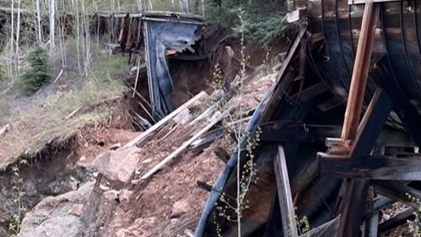
Crews have started the clean-up process in southwestern Colorado following the collapse of a 102-year-old wooden flume, which triggered a landslide and led to the closure of a section of the forest. The flume is located along Cascade Creek, west of Cascade Curve on U.S. 550, between Silverton and Durango, approximately two miles north of the Purgatory ski resort. According to Xcel Energy, this flume is one of only two remaining wooden flumes still operational in hydroelectric projects across the country.
The exact time of the break remains unclear. It is unknown whether it began as a small leak that gradually worsened or if it ruptured suddenly. However, water from the damaged flume caused a portion of the steep hillside below it to erode. This resulted in more of the flume's support structure being exposed and eventually failing, leading to a larger collapse.
Below the damaged flume, the terrain became unstable, with trees falling and nearby power line support structures at risk. In response, the U.S. Forest Service closed the area between the flume and the Cascade Creek hiking trail on June 6 for public safety, and it has remained closed since.
Xcel Energy and the U.S. Forest Service teams initiated work on the damaged site and began planning for potential repairs during the last week of June. A final report on the cause of the event is still pending, as per an Xcel spokesperson.
Historical Significance of the Flume
The flume was initially constructed as a box flume starting in 1903, with completion in 1904. It was part of a power supply project for mining operations in Silverton and Durango. Water diverted from the upper reaches of Cascade Creek was transported via the flume to Electra Lake, a reservoir created the following year in 1905. From there, the water descended 1,000 feet to the Tacoma Power Plant, located along the Animas River. This gravity-driven system generated power, delivering it to its first customer—a mine—early in 1906 through newly completed transmission lines.
Water from the highest snowpack travels 18 miles to the power plant, and after use, it is directed into the Animas River. According to Xcel, the Tacoma plant produces clean energy without causing water, air, or land pollution.
Throughout its history, the power plant has been accessible only by narrow-gauge train or track car. Construction materials were transported along these tracks, and the generators—originally intended for a power plant near Tacoma, Washington—arrived in crates labeled "Tacoma." These crates sat by the railroad siding for several weeks, leading people to refer to the railroad stop as "Tacoma," a name that stuck.
The flume itself also became known as both the Cascade Flume and the Tacoma Flume due to this association.
Repairs and Preservation Efforts
The original flume suffered from leaks, and in 1927-28, an upper portion was replaced with a semi-circular, 10-foot diameter, open-topped design made of creosoted Oregon fir. Its route was adjusted accordingly. Meanwhile, the lower portion of the flume was replaced with segments of buried steel pipeline between 1949 and 1952.
In June, a section of the 4,400-foot-long upper portion collapsed. Despite this, power delivery has not been interrupted because of the water reserved in Electra Lake. However, water flow in Cascade Creek to private properties below the damaged flume has been limited by debris.
The U.S. Forest Service claims that the Cascade Flume and Pipeline site is eligible for listing on the National Register of Historic Places. Although it has not been formally nominated, it still meets the definition of a historic property under the National Historic Preservation Act, according to a USFS spokesperson.
Repairing the flume will involve a complex approval process and multiple parties, including the Federal Energy Regulation Commission. A meeting is planned this week to discuss the next steps.
Ownership and Maintenance
Over its long history, the ownership of the flume has changed several times. Public Service Company of Colorado, now a subsidiary of Xcel, acquired it in 1992. The company has used a combination of employees and outside contractors to maintain the flume.
According to the U.S. Forest Service archives, "The head works, wooden flume (a portion of which recently collapsed), siphon intake structure, the portion of the siphon crossing Cascade Creek on a bridge and the siphon outlet structure are important visual elements of a functioning historical water delivery system. Although neither the flume nor the siphon was particularly unusual at the time they were constructed, through attrition they have become an unusual surviving example of historical technology that has often been replaced by more modern conveyances."

Post a Comment for "Collapsed Colorado flume triggers landslide disaster"
Post a Comment