Astronomers Unveil Secrets of Two Star Clusters
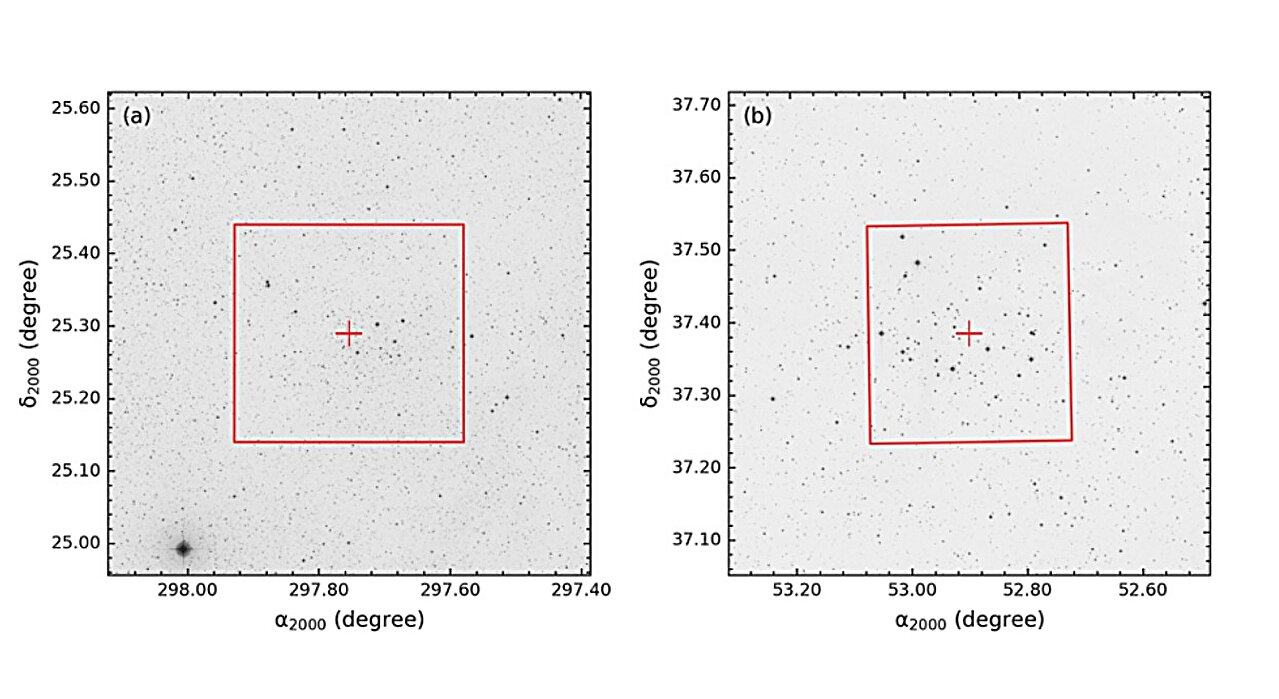
New Insights into Two Open Clusters: Czernik 41 and NGC 1342
Astronomers from Istanbul University in Turkey, along with colleagues from other institutions, have conducted a detailed study of two open clusters—Czernik 41 and NGC 1342. This research, published on the arXiv preprint server, provides new insights into the properties of these celestial objects. The findings are significant for understanding the formation and evolution of our galaxy.
Understanding Open Clusters
Open clusters (OCs) are groups of stars that formed from the same giant molecular cloud and are loosely bound by gravity. These clusters are of great interest to astronomers because they offer clues about how stars form and evolve over time. By studying OCs, scientists can gain a better understanding of the structure and history of the Milky Way.
In this study, researchers led by Burçin Tanık Öztürk from Istanbul University focused on two well-known OCs: Czernik 41, discovered in 1966, and NGC 1342, also known as the Stingray Cluster, which was first identified by William Herschel in 1799. To gather data, the team used the T100 telescope at the TUBITAK National Observatory in Turkey and analyzed information from the Gaia satellite.
Methodology and Findings
The researchers employed CCD UBV photometry and Gaia data to investigate the structural, astrophysical, kinematic, and galactic orbital parameters of both clusters. They determined the membership probabilities of stars within each cluster, as well as their mean proper motions and distances. The analysis focused on stars with high-probability membership to derive accurate astrophysical and dynamical parameters.
The study found that Czernik 41 has a denser stellar population compared to NGC 1342. Specifically, the team identified 382 high-probability members in Czernik 41 and 111 in NGC 1342.
Czernik 41 was found to have a radius of 25.9 light years, a metallicity of 0.07 dex, and an estimated age of 69 million years. It is located approximately 8,100 light years away from Earth. In contrast, NGC 1342 is much older, with an estimated age of about 1 billion years. The cluster has a smaller radius of 6.7 light years, a metallicity of around -0.14 dex, and is situated roughly 2,100 light years from Earth.
Kinematic and Orbital Parameters
The mean radial velocities of Czernik 41 and NGC 1342 were calculated to be 2.41 km/s and -10.48 km/s, respectively. Additionally, the study suggests that both clusters may have reached dynamical relaxation. The relaxation times for Czernik 41 and NGC 1342 were estimated to be 37.31 million years and 4.44 million years, respectively.
Orbital analysis revealed distinct paths for each cluster. The researchers noted that Czernik 41 likely originated within the solar circle and remains in that region, while NGC 1342 formed outside the solar circle and has since moved inward.
Implications for Galactic Studies
This research contributes valuable data to the field of astronomy, particularly in the study of open clusters and their role in understanding galactic dynamics. The combination of ground-based observations using the T100 telescope and space-based data from Gaia allowed for a comprehensive analysis of the clusters' properties.
By examining the structural and kinematic characteristics of these clusters, scientists can refine models of star formation and galactic evolution. The results highlight the importance of continued observational campaigns and the use of advanced instruments like Gaia to explore the universe in greater detail.
Conclusion
The study of Czernik 41 and NGC 1342 represents a significant step forward in our understanding of open clusters and their place in the broader context of galactic science. As more data becomes available, future research will build upon these findings to further unravel the mysteries of the cosmos.

Post a Comment for "Astronomers Unveil Secrets of Two Star Clusters"
Post a Comment